
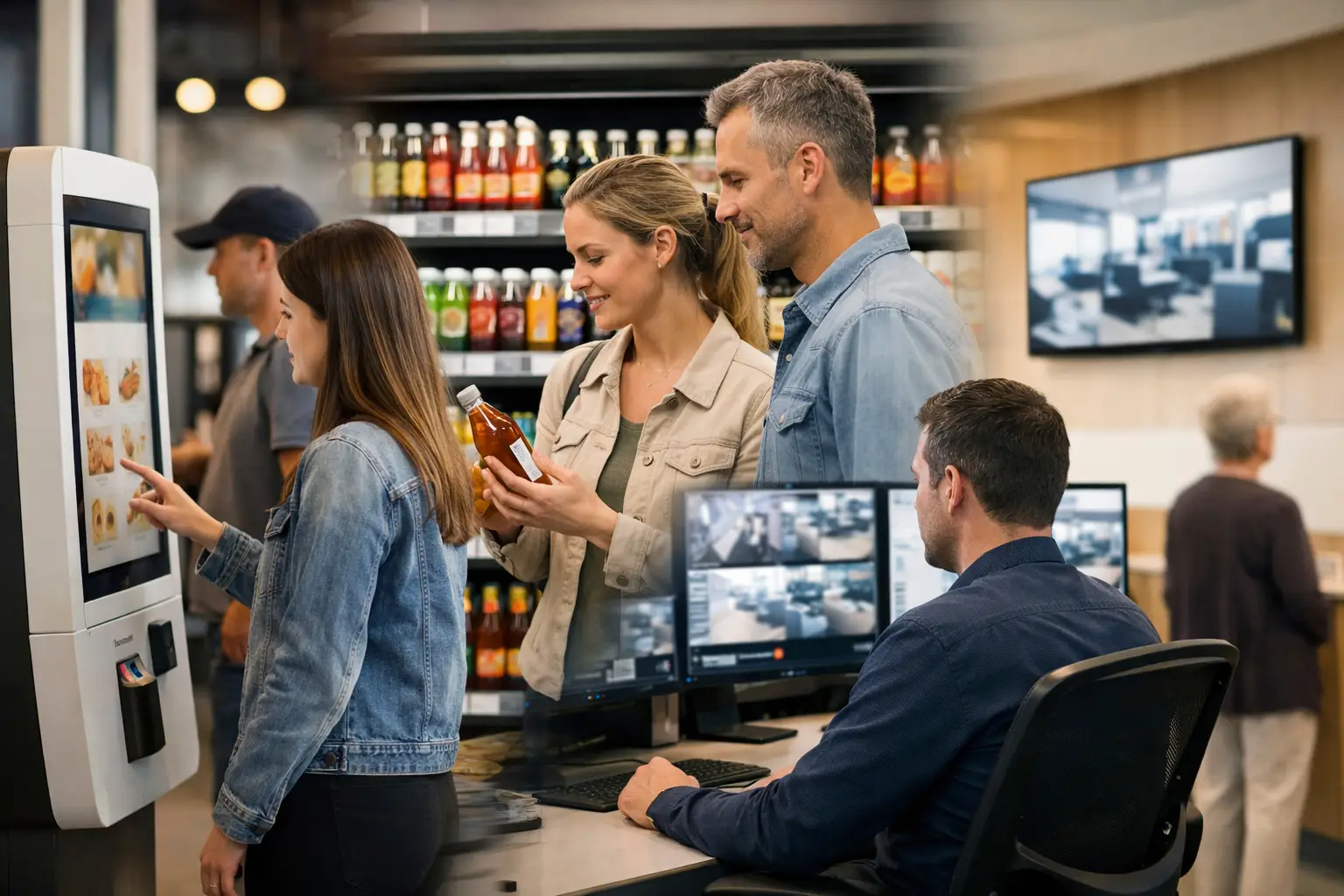
A blank menu board during the lunch rush is not a minor technical defect. It can slow ordering, create inconsistency between locations, and leave teams without the information customers need. To reduce commercial display downtime, organizations need more than a replacement-screen process. They need an operating model that detects faults early, restores service remotely where possible, and creates traceability when physical intervention is required.
For distributed display networks, availability is the result of architecture, governance, hardware selection, and day-to-day operational discipline. A commercial display can be healthy at installation and still become unreliable if media players are unmanaged, network dependencies are unclear, power quality is inconsistent, or no team owns the response to alerts.
Why commercial display downtime is an operational issue
Commercial displays support very different levels of operational criticality. In a retail store, an inactive promotion screen can affect campaign execution and revenue. In a quick-service restaurant, a failed digital menu board can affect queue flow and ordering confidence. In a control room, a video wall outage may reduce situational awareness for operators who rely on real-time visual information.
The appropriate response model depends on that criticality. A back-office screen may tolerate a next-business-day repair. A menu board, wayfinding display, transaction-facing kiosk, or command-center visualization may require immediate remote remediation and a defined field-service escalation path.
The common mistake is treating every incident as a hardware problem. In practice, many outages originate in the layer around the panel: an application crash, a disconnected player, a failed content download, an expired certificate, a network change, an incorrect schedule, or an unsuccessful firmware update. If the organization cannot distinguish among these causes quickly, mean time to repair rises even when replacement hardware is available.
Build the architecture to reduce commercial display downtime
The most effective availability strategy begins before deployment. It defines how devices are registered, monitored, secured, grouped, updated, and recovered across the network. DEX Manager is designed to provide that centralized control layer for digital signage and distributed display environments, whether deployed by SIA Interactive or through a certified partner.
Monitor the device, player, content, and connection
A display reporting as online does not prove the audience sees the intended message. Operations teams need visibility across the full delivery chain: panel status, media player health, application status, network connectivity, content synchronization, scheduled playback, and proof of play where campaign accountability matters.
Centralized monitoring should identify exceptions by site, region, device group, or business function. That prevents a team from working through hundreds of nominally healthy endpoints to locate the few that require action. It also supports prioritization. An alert from a single staff-room display should not be handled the same way as an alert affecting every screen in a flagship location.
Visual verification adds another level of assurance. For selected environments, screenshots or camera-based validation can reveal black screens, frozen content, incorrect layouts, or a panel showing the wrong source. This is particularly valuable when a device has network connectivity but the customer-facing experience has still failed.
Automate recovery before dispatching a technician
Remote remediation is often the fastest way to restore service. The platform should enable defined actions such as restarting the player application, rebooting the operating system, republishing content, switching to an approved fallback playlist, or restarting a display through managed power control.
Automation requires restraint. Rebooting a device repeatedly without investigating the cause can conceal an application defect, unstable network, or power issue. A better approach is to establish escalation logic: attempt a controlled recovery action, confirm whether the endpoint returns to its expected state, then create an incident for human review if the fault persists.
For business-critical screens, fallback content is not just a design preference. It is a continuity measure. A restaurant can retain a simplified menu, a bank can show essential customer information, and a retail network can preserve brand-safe messaging while the primary content source is restored. The fallback must be stored locally and tested under genuine network-loss conditions, not only documented in a deployment plan.
Separate content incidents from infrastructure incidents
A display network becomes difficult to operate when every fault lands in the same support queue. Content owners need to know whether a campaign was published correctly. IT teams need evidence of network and endpoint health. Facilities teams may own power, mounting, cooling, and physical access. Service partners need a clear work order with device identity, location, fault history, and required spare parts.
This separation creates governance rather than fragmentation. Each team sees the information relevant to its responsibility while a central operational view retains the full incident record. The result is faster diagnosis and better accountability across regional deployments.
Governance turns alerts into uptime
Monitoring alone does not improve availability if alerts are not tied to a response process. Organizations should define service levels by business impact, not simply by device type. A practical model classifies devices into critical, important, and standard categories, each with its own response time, remote-recovery sequence, and field-service target.
The operating model should also establish ownership for common decisions. Who approves emergency content replacement? Who can reboot a player remotely? When does a recurring fault trigger device replacement rather than another reset? Who validates that a repaired screen is showing the correct content? These questions matter most when the network spans multiple countries, internal teams, and certified delivery partners.
Asset records are equally important. Every endpoint should have a unique identifier, physical location, hardware model, serial number, warranty status, firmware version, network configuration, and support history. Without that traceability, a technician may arrive on site with the wrong part or spend time locating a device that was renamed after a store refit.
ISO-aligned operational practices help here because they formalize change control, access rights, incident records, and corrective action. They reduce the risk that a well-intended emergency fix creates a wider configuration problem across the network.
Select hardware for the real operating environment
Commercial-grade hardware is necessary, but the specification must match the use case. Screen brightness, duty cycle, orientation, temperature range, ingress protection, and mounting conditions directly affect reliability. A panel selected for a climate-controlled corporate lobby may fail early in a sun-exposed storefront or a hot kitchen pickup area.
Power and connectivity deserve the same attention. Unmanaged power cycling, overloaded circuits, weak Wi-Fi, and poorly protected network equipment can create intermittent faults that appear to be display failures. For high-criticality environments, organizations may need wired connectivity, managed network segmentation, uninterruptible power for core equipment, and remotely controllable power distribution.
Redundancy has trade-offs. A spare player at every location improves recovery time but increases capital cost, inventory management, and configuration discipline. For a network of standard promotional screens, regional spares and defined swap procedures may be sufficient. For a control-room video wall or a high-volume ordering zone, local redundancy can be justified by the cost of interruption.
Manage change without creating avoidable outages
Many display failures occur after a change, not before it. New content templates, operating-system patches, player software releases, network policy changes, and certificate renewals can all affect endpoint behavior. A controlled release process is therefore part of availability management.
Test updates on a representative pilot group before broad release. Include different hardware models, screen orientations, network conditions, and geographic locations. Schedule production changes outside peak operating periods where possible, and retain a documented rollback method if the update creates an unexpected issue.
This approach is especially relevant for organizations running thousands of endpoints. A minor configuration error, multiplied across a large estate, can become a material continuity event. Centralized deployment through DEX Manager supports consistent configuration and controlled distribution, but teams still need approval workflows and clear validation criteria.
Use incident data to improve the network
The purpose of reporting is not to produce a monthly dashboard with attractive percentages. It is to identify recurring causes of downtime and remove them. Track availability by location, device type, application version, content template, and incident category. Compare mean time to detect, mean time to restore, repeat incident rate, and the proportion of cases resolved remotely.
Patterns often reveal where investment should go. A cluster of player failures after long operating hours may point to thermal management. Repeated content-sync incidents may indicate bandwidth constraints or publishing workflow errors. Frequent panel replacements at one site may expose power instability or unsuitable hardware placement.
For retail, QSR, banking, corporate communications, and control-center operations, the goal is the same: a display estate that can be governed as a service rather than maintained as a collection of isolated screens. When visibility, automated recovery, lifecycle control, and accountable support work together, uptime becomes a managed operational outcome instead of a recurring emergency.