
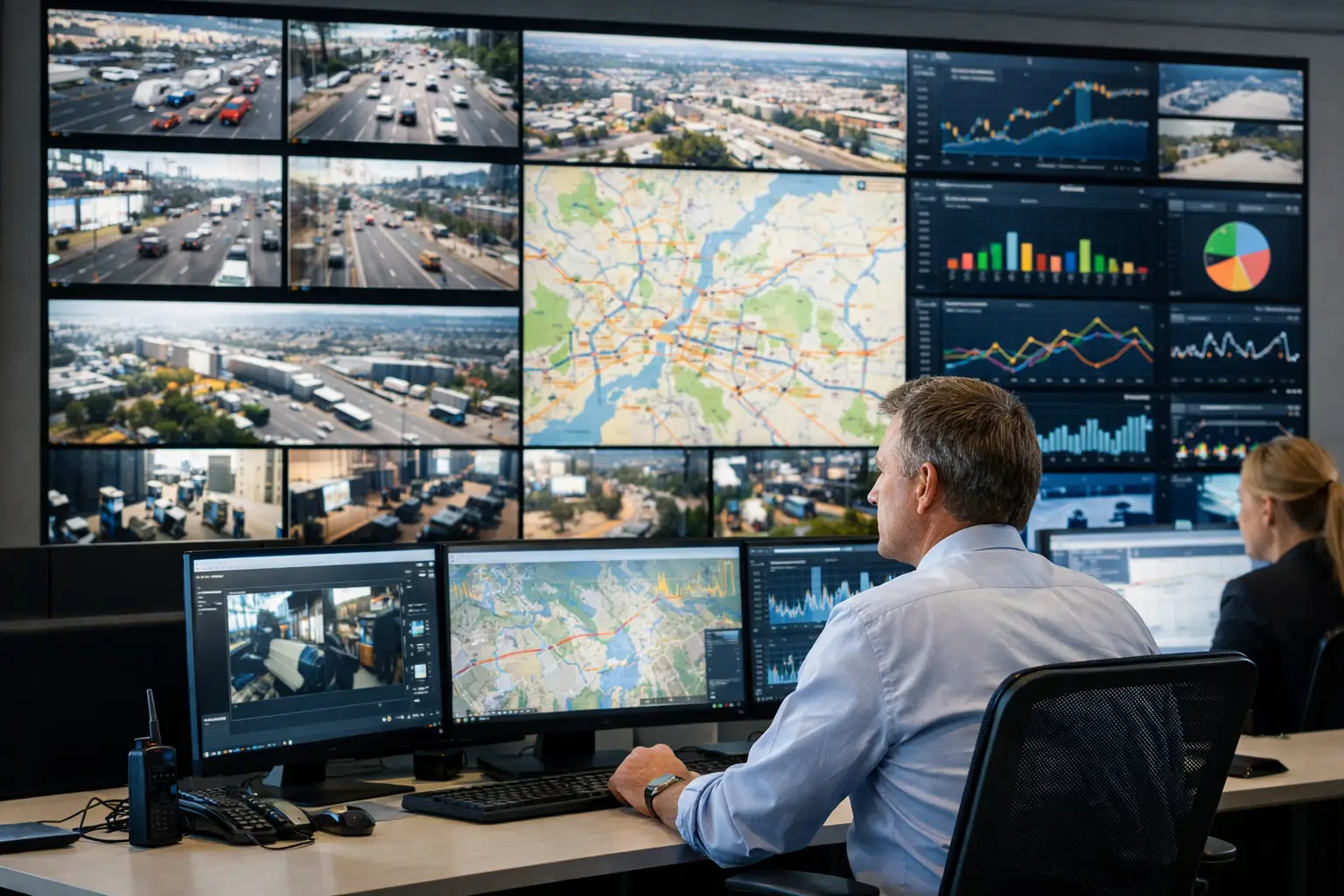
A video wall is rarely just a collection of large screens. In a security operations center, it is where teams see incidents develop. In a retail command center, it may expose store performance, queues, and campaign status across a regional network. In corporate environments, it can be the shared visual layer for communications, meetings, and business continuity. Video wall management determines whether that layer remains reliable under pressure or becomes another unmanaged endpoint.
The operational challenge is not making content appear on a wall. It is maintaining control over what is shown, who can change it, how quickly teams can respond, and whether the system continues to operate across changing sites, data sources, and priorities. For organizations managing critical physical spaces, the answer requires more than a media player and a scheduling tool. It requires an architecture for governance, monitoring, integration, and continuity.
What video wall management must control
Effective video wall management brings the display environment into the same operating model as other critical technology assets. Operators need to control layouts, sources, campaigns, permissions, schedules, device status, and incident response from a central interface. Local teams still need practical autonomy, but within rules that prevent unapproved content, conflicting schedules, or untraceable changes.
That distinction matters when a wall supports real-time decision-making. A control room operator may need to switch from a standard dashboard to camera feeds, alarm data, transport information, or an emergency layout in seconds. A retail operations team may need to replace a promotional message across hundreds of screens when inventory changes or a campaign is withdrawn. These are different workflows, but both depend on central governance and reliable execution at the endpoint.
C-Control is designed for environments where control of the physical space and its visual systems must be coordinated in real time. It can bring displays, video walls, connected devices, sensors, and operational workflows into one control layer. DEX Manager provides the complementary management capability for distributed digital signage and communication networks, giving teams centralized publishing, scheduling, monitoring, and device governance.
The appropriate platform configuration depends on the use case. A single corporate lobby wall has different requirements from a 24/7 operations center or a multi-country retail network. The common requirement is traceability: teams must know what was displayed, what changed, which device received the instruction, and whether it was executed successfully.
Video wall management is an uptime discipline
Large displays are highly visible, which makes failures highly visible too. A black panel, an incorrect source, a frozen dashboard, or an outdated message can immediately affect customer experience, operator confidence, or incident response. Managing a video wall therefore involves active health monitoring, not just content administration.
A production-ready operating model should monitor the status of displays, players, connections, and source availability. It should identify whether a problem is isolated to one panel, related to the network, or caused by a source system. Remote diagnostics reduce unnecessary site visits, while controlled restart and recovery procedures help restore service quickly when local intervention is not required.
The trade-off is clear. A simple standalone installation may have a lower initial setup cost, but it often shifts risk to local teams and provides limited visibility once the wall is deployed. Centralized management requires more planning around network design, user roles, and integration, yet it substantially improves operational continuity as the environment grows.
For organizations operating across multiple sites, 24/7 support capability also becomes part of the technical architecture. Display availability is not only a hardware question. It depends on defined escalation paths, platform monitoring, access control, and a team that can distinguish a content issue from a device, network, or source failure.
Design the control model before selecting screens
Video wall projects often begin with specifications such as panel size, bezel width, brightness, or LED pixel pitch. Those decisions matter, especially for viewing distance, ambient light, and operating hours. But the more consequential design question is how the wall will be managed after handover.
Start by defining the operational scenarios. What should appear during normal operation? Who is allowed to change layouts? Which sources are essential during an incident? Does the wall need local control if connectivity to a central environment is interrupted? How long can the environment operate with degraded functionality?
These questions produce concrete requirements for the management platform. They also reveal where standardization is valuable. A central operations team may require approved layout templates, role-based access, and automated scheduling. Local facilities or communications teams may need the ability to select from approved content and activate specific messages for their site. The platform should support both without creating parallel, unmanaged workflows.
Hardware selection follows the same principle. Commercial displays, LED systems, video processors, media players, mounts, and network components should be selected as an integrated operating environment. Consumer-grade screens may be acceptable for low-use internal applications, but they are usually a poor fit for high-visibility, extended-hour, or mission-critical deployments. Serviceability, remote management support, operating-hour ratings, and replacement strategy should be considered alongside image quality.
Integrate data without creating visual noise
The value of a video wall often comes from its ability to combine information that would otherwise sit in separate systems. Cameras, IoT sensors, building management platforms, queue systems, operational dashboards, alerts, maps, and enterprise applications can all contribute to a more complete operational picture.
Integration, however, is not automatically useful. A wall crowded with live data can slow decisions if operators cannot identify what needs attention. The design should distinguish between persistent awareness information, active alerts, and detailed investigation views. A security team may keep a site map and key camera feeds visible while opening additional sources only when an alert occurs. A retail team may maintain high-level store metrics and use exceptions to trigger a closer review.
C-Control supports this type of coordinated physical-space control by connecting visual outputs with data, devices, and operator actions. The objective is not to display every available signal. It is to provide the right view for the current operational state and enable fast, governed changes when that state changes.
Governance makes distributed operation practical
As video walls expand across offices, stores, campuses, transport sites, or control centers, local flexibility must coexist with central standards. Without governance, teams create inconsistent layouts, stale content remains in circulation, and nobody has a clear audit trail when an error occurs.
A sound governance model defines content ownership, approval rights, publishing responsibilities, emergency authority, and retention of operational logs. It should also define the difference between a scheduled change and an immediate override. During a critical event, an authorized operator must be able to take control quickly. Afterward, the organization must be able to review the action and restore the standard configuration.
Cloud-based platforms make this model easier to operate across distributed estates, provided the infrastructure is designed for enterprise security and availability. SIA Interactive's platforms operate on Microsoft Azure-certified infrastructure and are supported by ISO 27001 and ISO 9001-certified processes. That foundation is relevant because video wall management increasingly sits alongside customer information, operational data, camera feeds, and connected physical devices.
Practical applications across physical networks
In control centers, the focus is situational awareness and rapid response. Teams need controlled access to live sources, predefined incident layouts, and confidence that visual information remains available throughout long operating periods.
For retailers and supermarkets, a wall can support store operations, campaign coordination, queue visibility, and internal communication. DEX Manager can centralize the scheduling and governance of customer-facing and staff-facing display networks, while operational teams retain visibility across locations.
In quick-service restaurants, video walls and digital menu environments must react to changing dayparts, product availability, and local operating conditions. Central scheduling reduces manual updates, while integrations can support more responsive communication when menus, promotions, or service flows change.
Corporate enterprises use walls for executive briefings, internal communications, visitor spaces, and business continuity environments. Here, permission structures and visual consistency are often as important as the ability to show live data.
Build for the operating day, not the launch day
The strongest video wall projects are planned around ordinary operational pressure: staffing changes, source failures, late campaign updates, network interruptions, and urgent requests from leadership. This is where centralized software, monitored hardware, defined governance, and qualified delivery partners prove their value.
DEX Manager and C-Control can be deployed by SIA Interactive or through its certified partner network, allowing organizations to align local delivery capability with a common technology and governance model. The result is not simply a better-looking wall. It is a visual operating environment that remains controlled when attention, speed, and reliability matter most.
Before approving the next display specification, ask a more useful question: when the wall needs to change at 2 a.m., during an incident, or across 200 locations, who has control and how will they know it worked?