
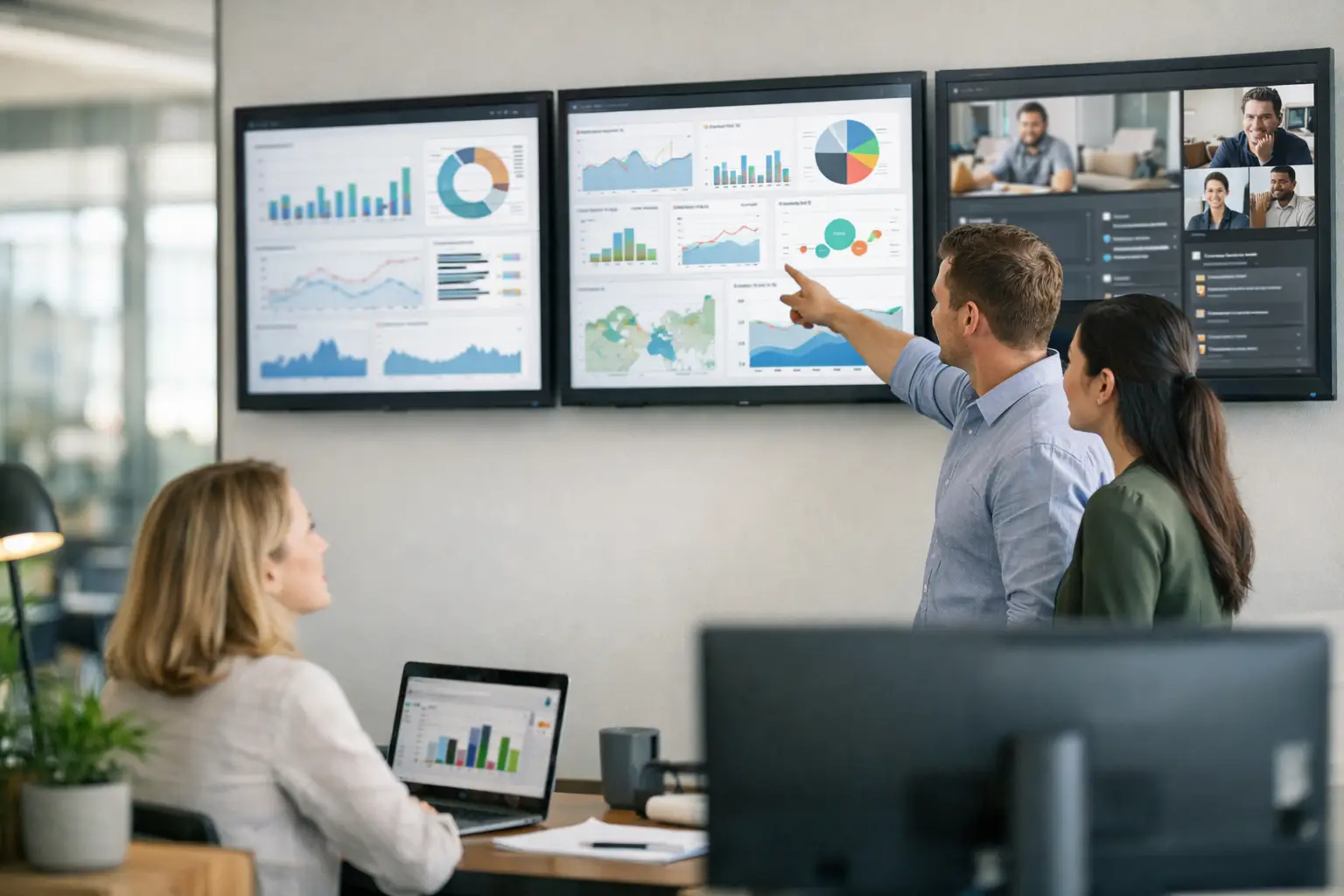
A delayed shift handover, an unavailable meeting room, a safety alert, and a visitor arriving at reception are not separate communication problems. They are operational events that need to reach the right people in the right physical location. Office communication dashboard screens provide that visible, shared layer of information, without asking employees to search through email, chat channels, or disconnected intranets.
For enterprise organizations, the screen is only the endpoint. The harder requirement is governance: who can publish, which data source is trusted, what happens when a network connection fails, and how hundreds of displays remain current across offices. A dashboard that looks polished but cannot be governed at scale quickly becomes another unmanaged channel.
Start with the operational decision, not the display
An office dashboard should help someone act, not simply fill a wall with content. A facilities team may need to see open incidents, room occupancy, and service-level performance. Employees may need an immediate view of corporate updates, transport disruptions, emergency messaging, and workplace availability. Visitors need wayfinding and timely instructions without exposure to internal data.
These audiences can share a display network, but they should not receive the same dashboard. The practical design question is: what decision or behavior should this screen support at this location? That answer determines the data, layout, refresh rate, permissions, and fallback content.
A screen in a lobby can prioritize visitor information and brand-approved announcements. Screens near elevators may carry concise operational notices and event updates. A workplace operations center may require live incident status, IoT sensor data, camera views, and escalation indicators. Trying to place all of this on one generic template reduces readability and creates unnecessary information exposure.
Office communication dashboard screens need content governance
The most visible failure mode is stale content. The more serious failure is untraceable content: an outdated emergency instruction, a local manager changing a corporate message without approval, or a dashboard showing data that has not refreshed but appears live.
A governed platform needs role-based access, approval workflows where appropriate, scheduling controls, and an audit trail. Corporate communications can control approved templates and global campaigns, while facilities teams update local service notices within defined permissions. Regional teams can schedule language variants and local announcements without overriding enterprise standards.
This is also where operational criticality changes the architecture. Not every item needs real-time delivery. A quarterly leadership message can be scheduled in advance. A building closure, severe weather alert, or safety instruction must interrupt routine content according to defined priority rules. Clear escalation logic prevents an emergency message from competing with cafeteria menus or internal event promotions.
Governance should extend to the data itself. If a dashboard displays occupancy, queue status, room availability, or production metrics, each source needs an identified owner and a defined refresh expectation. A static label such as “live” is not enough. Teams should be able to distinguish a current feed from a delayed or unavailable integration.
DEX Manager provides centralized control at scale
DEX Manager is designed to manage digital signage networks where content, devices, and operational status need to be controlled from a central platform. It can be deployed by SIA Interactive or a certified partner, allowing organizations to standardize the technology while selecting the delivery model that fits their regional estate and operating structure.
For office communication, centralized control matters because displays are rarely limited to one headquarters. A typical network can include reception displays, cafeteria menu boards, employee communication screens, executive briefing areas, meeting-room zones, and remote offices. Each group may require different playlists, data permissions, operating hours, and screen configurations.
DEX Manager supports this through device grouping, scheduling, remote monitoring, and content distribution across distributed locations. A communications team can publish an approved campaign across selected offices while facilities managers retain local control over building-specific content. The result is not simply faster publishing. It is traceability over where information appeared, when it was scheduled, and whether the device was operating as expected.
This distinction becomes material during high-priority communications. A centrally managed emergency playlist can be targeted by geography, building, floor, or screen group. Once the event is over, the network can return to planned programming without requiring manual intervention on every display.
Integrate operational data without creating dashboard noise
The value of dashboard screens increases when they connect to the systems employees already depend on. Common integrations include room-booking platforms, visitor management systems, building management systems, help desk tools, transportation feeds, workforce applications, and IoT sensors.
Integration alone is not a measure of success. The screen must present the information in a form that can be read in seconds from the expected viewing distance. A dense control-room display may be appropriate for trained operators standing nearby. It is ineffective in a corridor where people are walking past.
Good dashboard design establishes a hierarchy. The current status comes first, the required action follows, and supporting detail remains secondary. Color can signal priority, but it should not be the only indicator. Short labels, timestamps, icons, and clear states such as normal, attention required, or service unavailable make the display more reliable for diverse audiences.
There is also a security trade-off. An executive operations dashboard may contain sensitive performance, security, or personnel information that should never be shown in a public lobby. Segmented screen groups and access-controlled content zones are therefore part of the communication architecture, not an optional feature. Public, employee-only, and restricted operational screens should be treated as distinct channels.
Design for uptime, recovery, and remote operations
An office display network is physical infrastructure. It needs the same operational thinking applied to other connected estate: monitoring, remote support, device lifecycle planning, and resilience when local conditions change.
Commercial-grade displays and media players are preferable where screens run for extended hours or support critical messaging. Consumer hardware may appear cost-effective at purchase, but failure rates, limited remote management, inconsistent brightness, and shorter lifecycle support can increase the total operating burden. The right hardware depends on viewing conditions, operating hours, and the consequence of downtime.
The software layer should provide evidence of availability. Teams need to know whether a screen is online, whether the player is responding, and whether scheduled content has been delivered. A black screen at a regional office can otherwise remain unnoticed until someone reports it. Central monitoring reduces this dependency on local manual checks.
Network interruptions should also be planned for. Local playback and predefined fallback content help maintain continuity when connectivity is temporarily unavailable. For a noncritical announcement screen, a fallback corporate playlist may be sufficient. For a safety-sensitive display, the fallback state and recovery process should be agreed with facilities, security, and business continuity stakeholders.
SIA Interactive operates its proprietary platforms within an ISO 27001 and ISO 9001-certified operating framework, with global 24/7 support capabilities for environments where device availability and controlled change matter. For large estates, this operational model is as relevant as the dashboard interface itself.
Measure whether the screens improve communication
Screen networks are often evaluated by content output: how many messages were published or how many screens are active. Those metrics describe activity, not operational value.
More useful measures depend on the use case. Facilities teams can assess reduced help desk inquiries about room availability, faster awareness of building incidents, or improved compliance with workplace instructions. Corporate communications teams can track campaign delivery by site and screen, then compare message timing with employee feedback or event attendance. For control-room environments, response time, alert acknowledgement, and display uptime are more relevant indicators.
Not every result will be attributable to a single screen. Employee behavior is influenced by email, managers, collaboration platforms, and the physical workplace. Still, dashboard screens have a particular strength: they communicate at the point where a decision is being made. That makes them valuable for location-specific information that gets lost in broad digital channels.
Where the model delivers the most value
Office communication dashboard screens are especially useful when the workplace has frequent operational change, a distributed footprint, or multiple audiences sharing the same physical environment. Corporate campuses can use them for visitor flow, room availability, and internal announcements. Banks can separate public service messages from employee operational updates. Retail headquarters and regional offices can connect performance communications with facilities status. Control centers can combine visual analytics, alarms, camera feeds, and operating procedures for trained teams.
The common requirement is not more screens. It is a controlled communication layer that links central policy with local conditions. When content governance, integrations, hardware reliability, and remote operations are designed together, the display network becomes a dependable part of workplace continuity - not a collection of digital posters competing for attention.
The best next step is to map the moments when people currently ask, wait, search, or miss an instruction inside the office. Those moments reveal where a dashboard screen can make communication visible, timely, and operationally accountable.