
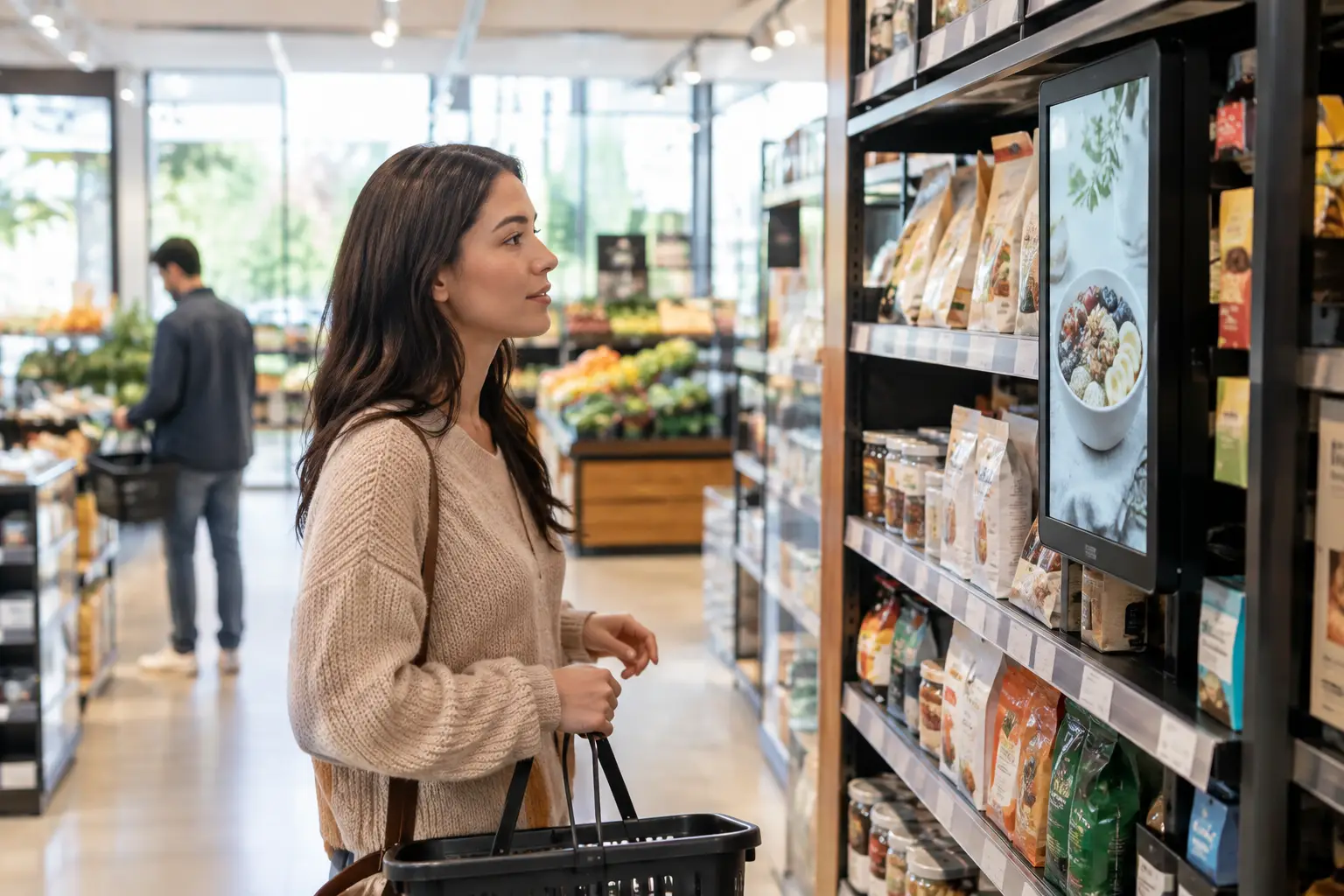
A promotion that reaches a shopper too late has little commercial value. The best in-store advertising formats place the right message at the point where a customer can still choose a product, add an item, change a route, or join a queue. For multi-site retailers, restaurants, and banks, the harder question is not which format looks most impressive. It is which format can be governed, updated, measured, and kept available across every location.
A screen at an entrance, a promotion beside a shelf, and a message on a self-service kiosk each solve different operational problems. Selecting the format starts with the customer decision to influence, then works backward through location, content cadence, hardware conditions, and platform architecture.
What makes an in-store advertising format effective?
Format should follow customer behavior, not available wall space. A high-impact LED display can create awareness at a storefront or food court, but it is rarely the best choice for a price-sensitive decision made in front of a shelf. Conversely, electronic shelf labels are precise at the shelf edge but are not designed to carry a brand campaign across a large retail environment.
For distributed estates, effectiveness also depends on operational control. Marketing teams need campaign flexibility, while operations and IT teams need approved templates, user permissions, proof of playback, device health monitoring, and a clear escalation path when a site goes offline. A format that performs well in one flagship store but requires manual updates at 300 locations introduces risk rather than scale.
The strongest programs connect four factors: shopper proximity to purchase, dwell time, content relevance, and reliable execution. The balance changes by sector. A quick-service restaurant may prioritize menu clarity and queue throughput. A supermarket may prioritize category conversion and promotion accuracy. A bank branch may need regulated messaging, wayfinding, and appointment guidance in the same physical network.
The best in-store advertising formats by use case
Digital signage for high-visibility campaign reach
Commercial displays remain one of the most flexible formats for entrance zones, aisle ends, waiting areas, service counters, and checkout lanes. They can combine campaign creative, local store information, time-sensitive promotions, and operational messages without replacing printed materials.
Their value is highest where shoppers have enough dwell time to absorb motion and changing content. Entrance displays can set a promotional agenda for the visit. Queue screens can promote add-on products or explain a service while customers wait. Endcap displays can reinforce a campaign that is already visible in the category.
The trade-off is content discipline. A digital display filled with too many messages becomes background noise. Retail networks should define campaign duration, creative rotation rules, local override permissions, and fallback content before deployment. Screen availability also matters. A black screen at the front of a store is a visible failure, so commercial-grade hardware and remote monitoring are part of the format decision, not an afterthought.
LED displays for storefronts and large spaces
LED is suited to environments where visibility, viewing distance, and ambient light exceed the capabilities of conventional displays. It is effective for storefront windows, shopping mall facades, atriums, transport-adjacent retail, and high-traffic food courts.
This format is built for reach rather than detailed product comparison. Creative should use strong contrast, limited copy, and messages that can be understood in seconds. For a retailer, that might mean a seasonal campaign, a limited-time offer, or a category-led visual rather than a dense product list.
LED also requires more planning than a standard screen network. Pixel pitch, sightlines, brightness, mounting conditions, maintenance access, and power requirements affect both cost and long-term reliability. The content platform must be able to schedule the LED estate alongside indoor displays while retaining different content rules for each screen type.
Shelf-edge media for the moment of choice
Shelf-edge formats operate where product comparison happens. They include electronic shelf labels, small digital shelf displays, and printed shelf communication. Their commercial strength comes from proximity: the shopper can see a price, promotion, product attribute, or stock-related message while standing in front of the category.
Electronic shelf labels are particularly useful when pricing changes frequently, promotions vary by location, or price integrity is a governance priority. Integration with pricing and product systems can reduce manual label changes and improve traceability between the price shown on the shelf and the price applied at checkout.
This is a precise format, not a broad-reach format. It works best for price, promotions, product comparisons, and operational data. Brand storytelling still belongs on larger formats elsewhere in the store. Retailers that use shelf-edge media for everything often compromise readability and distract from the decision it is meant to support.
Self-service kiosks and ordering screens
Kiosks are an advertising format with a direct transaction path. In restaurants, self-order screens can present meal upgrades, bundles, limited-time items, and allergy information at the point of order. In retail and banking, self-service devices can promote services, guide customers to digital channels, or provide personalized next steps.
The main advantage is context. The customer is already engaged in a task, so a relevant recommendation can drive conversion without requiring additional floor staff. The main constraint is usability. Promotions must not obstruct the ordering journey or add friction to an already busy queue.
Kiosk campaigns should be tested against operational indicators, not only impressions. Track basket value, attachment rate, abandoned sessions, transaction duration, and queue conditions. A promotion that increases average order value but slows ordering enough to reduce throughput may not be commercially positive during peak periods.
Video walls for destination zones and corporate environments
Video walls create a high-impact communication point in flagship stores, experience centers, bank branches, corporate lobbies, and command environments. They are appropriate where a large visual canvas supports a premium campaign, data visualization, or brand narrative.
Their commercial role differs from a shelf display. A video wall is typically a destination or orientation format. It can establish brand presence, communicate a major launch, or support event programming. It can also shift to operational content during an incident, making it valuable in environments where continuity of communication matters.
The operational requirement is synchronization. Every display in the wall must maintain consistent playback, layout, and status. Hardware selection, mounting accuracy, calibration, and centralized monitoring determine whether the wall remains a reliable asset or becomes a difficult maintenance point.
Build the format mix around store zones
Most large retail networks need a mix rather than a single format. Entrance and storefront zones create awareness. Aisles and endcaps reinforce campaigns near categories. Shelf-edge media supports product choice. Checkout, queue, and self-service zones can drive add-ons or provide service information.
This zoning approach prevents duplicated messaging. A shopper who sees the same generic campaign on every screen is less likely to respond than one who receives a progressive message: awareness at entry, product relevance in the category, and a transaction prompt at checkout.
Content governance should reflect these zones. National campaigns may be centrally controlled, while store managers can be allowed to publish approved local messages within defined templates. This preserves brand consistency without forcing every operational message through a central marketing team.
The platform requirement behind scalable in-store media
Advertising formats become difficult to manage when each hardware type has its own isolated interface. Screens, LED displays, kiosks, electronic labels, sensors, and cameras may generate separate workflows, credentials, and reporting gaps. That fragmentation limits both campaign speed and accountability.
A centralized platform such as DEX Manager provides the control layer for operating digital signage networks across locations and formats. Content scheduling, remote device management, permissions, status monitoring, proof of playback, and automated rules can be managed through one architecture. Integrations with business systems, IoT sensors, or audience conditions can also trigger context-aware content when the use case justifies the added complexity.
For example, a restaurant can shift menu promotions by daypart, while a retailer can publish location-specific campaign content without losing central governance. Where a device or connection fails, monitoring and alerts support faster intervention and reduce the time a customer-facing asset remains unavailable. DEX Manager can be deployed by SIA Interactive or through a certified partner network, depending on the delivery model and regional operating requirements.
Measurement should be designed before campaign launch. For high-visibility displays, measure uptime, playback compliance, dwell conditions, and campaign exposure where appropriate. For shelf-edge or kiosk formats, connect activity to price accuracy, conversion, basket value, order attachments, or queue performance. The useful metric is not always the same, but every format should have a defined commercial or operational purpose.
The right format is the one that makes a specific customer decision easier while remaining controllable at network scale. Start with the zone, the decision, and the operational requirement. Then choose the media that can deliver the message reliably, every day, in every location where it matters.