
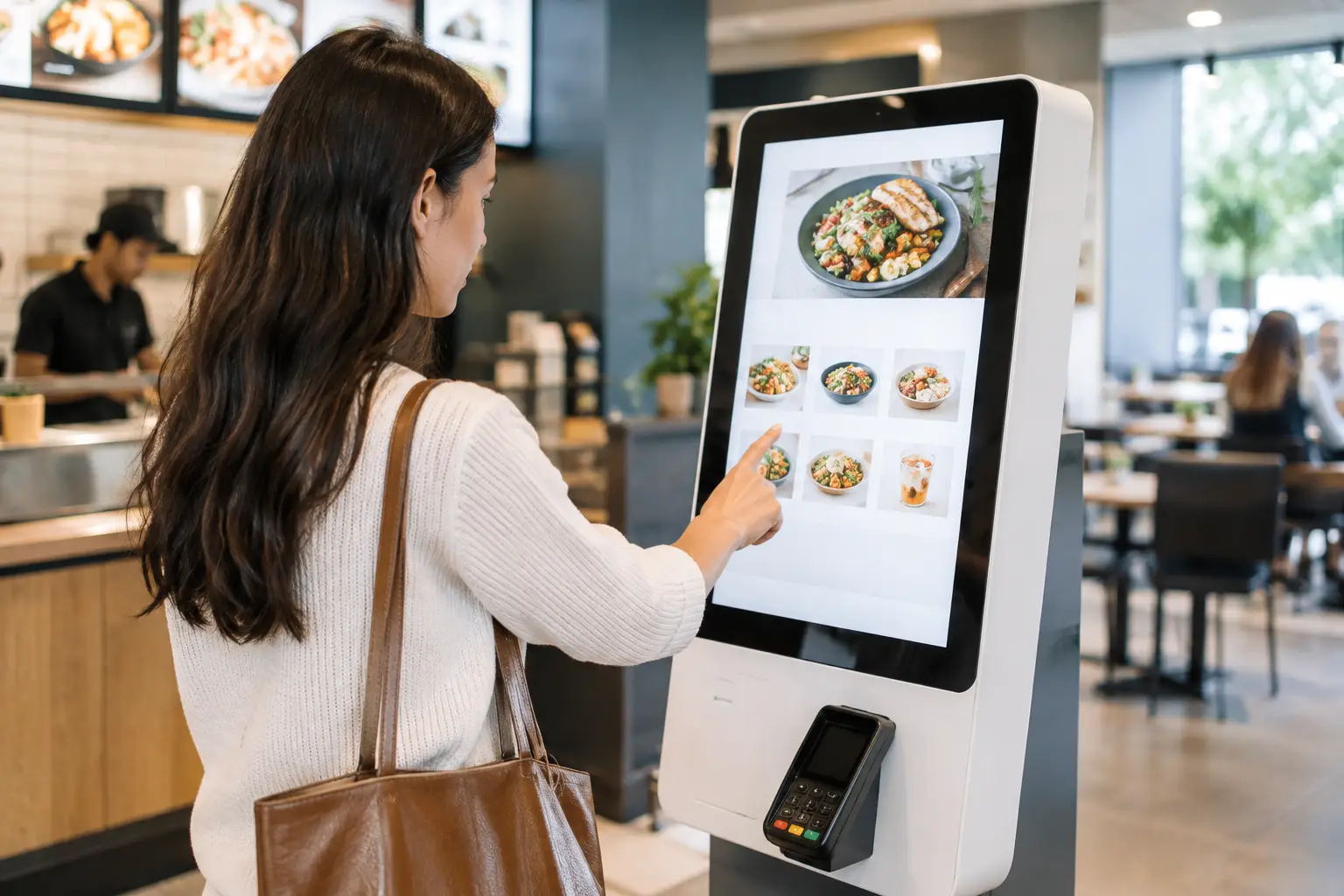
At a busy lunch period, an ordering screen is not a marketing touchpoint. It is part of the operating line. If it presents an unavailable item, loses a modifier, or falls out of sync with the kitchen, the impact is immediate: longer queues, rework, frustrated guests, and reduced throughput. Restaurant ordering interfaces therefore need to be designed as operational systems, with the same attention to availability, governance, and integration given to the point-of-sale environment.
For multi-site restaurant groups, the challenge is not simply choosing a kiosk or designing a better menu. It is maintaining a consistent, accurate ordering experience across hundreds or thousands of screens, locations, dayparts, languages, and promotional cycles. That calls for a managed architecture rather than a collection of isolated devices.
Why Restaurant Ordering Interfaces Become an Operations Issue
A guest sees a simple journey: browse the menu, customize an order, pay, and collect. Behind that journey sits a chain of dependencies. The interface must receive menu and price data from the POS or commerce platform, respect stock status and daypart rules, transfer the completed order reliably, and communicate the next step through a receipt, order-status display, or mobile notification.
Any break in that chain creates operational risk. A menu that is visually correct but commercially outdated can generate refund requests. A promotion launched centrally but not applied in a local market can affect margin and customer trust. A payment terminal issue can turn a self-order kiosk into an unplanned static display.
This is why local teams should not be left to manually update content, troubleshoot screens, and reconcile competing versions of the menu. Local flexibility matters, particularly where stores have different trading hours, assortments, or language requirements. But flexibility needs controlled boundaries. Central teams need governance over the elements that affect brand, price, compliance, and revenue.
The Architecture Behind Reliable Ordering
Reliable restaurant ordering interfaces connect several layers that must operate together: the customer-facing device, the interface application, the content and menu data layer, payment services, the POS, and kitchen production systems. The correct architecture depends on the existing technology estate, but the operating principle is consistent: each layer needs clear ownership, monitoring, and a defined behavior when connectivity is interrupted.
For example, a restaurant group may require the interface to retrieve menu availability in near real time, while promotional assets and interface layouts are scheduled centrally. The kiosk hardware must support commercial duty cycles, payment peripherals, scanners where loyalty or coupon journeys require them, and remote device management. The display itself must be specified for the physical environment, including brightness, orientation, cleaning requirements, and expected daily operating hours.
A lower-cost consumer display can appear suitable in a pilot and become expensive in a high-traffic rollout when replacement rates, remote diagnostics, and mounting constraints are considered. The same is true of tablet-based ordering. It can suit table service or temporary formats, but may not provide the physical resilience, peripheral options, or controlled deployment model required for a large quick-service network.
The key decision is not kiosk versus counter ordering, or cloud versus local processing in isolation. It is whether the chosen combination supports continuity of operations when the restaurant is under pressure.
Integration Must Reflect the Actual Order Flow
The order flow should be mapped before the interface is designed. That includes menu synchronization, pricing, taxes, allergens, product availability, modifiers, discounts, payment authorization, order injection into the POS, kitchen routing, refund handling, and reporting. A polished front end cannot compensate for ambiguous integration logic.
Consider item availability. If a product is unavailable, the interface should remove it or clearly prevent selection before payment. If substitutions are permitted, they should follow centrally defined rules rather than rely on a store employee to resolve every exception. For complex menus, these details affect both guest conversion and kitchen workload.
Integration requirements also vary by format. A drive-through ordering journey has different timing and confirmation needs from a food court kiosk. A corporate restaurant may need employee identification and subsidized meal rules. A casual dining operation may prioritize table numbers, split payments, and service recovery. Standardizing the platform does not mean forcing identical customer journeys.
Central Governance Without Slowing Local Operations
Restaurant chains often face a false choice between central control and local responsiveness. The better model is role-based governance. Central teams define templates, approved components, menu logic, campaign rules, and release processes. Regional or store teams can activate permitted content, respond to local stock conditions, and manage exceptions within that framework.
This model creates traceability. Operations leaders can see which menu version was active at a particular restaurant, when it changed, who approved it, and whether the device received the update. That history matters when investigating a pricing dispute, assessing campaign performance, or resolving a service issue.
A central content and device platform such as DEX Manager supports this operating model by managing screens, kiosks, content schedules, and remote device status from one control environment. It can be deployed by SIA Interactive or through a certified partner network, depending on the delivery model and local operating requirements. The platform role is not only to publish creative assets. It is to maintain control over what is running, where it is running, and whether the physical endpoint is operating as intended.
For distributed estates, governance should also cover release management. A new interface design, payment update, or menu structure should be validated in a controlled pilot, released in stages, and monitored against agreed operational measures. A network-wide push may be appropriate for an urgent price correction, but it is a poor default for changes that affect the ordering path.
Design for Throughput, Not Just Conversion
Conversion matters, but restaurants also need to measure the time and friction required to complete an order. An interface that promotes high-margin add-ons while adding multiple unnecessary steps may reduce total transaction capacity at peak periods. The right design balances average check value against queue length, kitchen capacity, and the guest's tolerance for delay.
The practical measures are straightforward: order completion rate, average time to order, abandoned sessions, payment failures, intervention rate, average items per transaction, and queue duration. These metrics should be reviewed by location, daypart, device type, and menu configuration. A strong overall result can conceal a poor lunch-period experience in a subset of high-volume sites.
Interface design should also anticipate human behavior. Guests need clear categories, readable pricing, visible dietary information, and confirmation before payment. Frequent customers benefit from fast repeat-order paths, while first-time visitors need sufficient explanation without being forced through a tutorial. Accessibility is not a secondary design task. Screen height, touch targets, contrast, language selection, and alternative ordering paths all influence whether the system can serve the full customer base.
Uptime Is a Commercial Metric
A kiosk that is offline for two hours is not merely an IT incident. It changes labor allocation, queue capacity, and potential revenue during that period. For this reason, device health needs continuous oversight rather than periodic store checks.
Remote monitoring should identify screen status, application availability, network connectivity, peripheral condition, and abnormal usage patterns. A device may be powered on while still unable to accept payments or send orders. Operational monitoring needs to distinguish between those states and direct the correct response.
This is where commercial hardware and centralized management work together. Certified displays, kiosks, payment peripherals, and network components reduce avoidable failures, while the software layer provides visibility across the estate. Global 24/7 operations are especially relevant for brands spanning multiple time zones or extended trading hours, where a fault cannot wait for a local office to open.
Continuity planning should define the fallback experience as well. Can orders be redirected to another kiosk? Can the restaurant revert to counter ordering with current menu information? Can staff identify that a transaction was authorized but not injected into the POS? Clear answers prevent a technical fault from becoming a customer-facing dispute.
Build an Interface Estate That Can Change
Restaurant ordering interfaces should be treated as a managed estate, not a one-time deployment. Menus change, payment methods evolve, store formats expand, and customer expectations move quickly. The value of the platform lies in making those changes controlled, observable, and repeatable across the network.
The most useful next step is to map one high-volume ordering journey from menu update to kitchen handoff, then identify where visibility, ownership, or fallback procedures are missing. That exercise usually reveals whether the current interface is simply attractive on screen or genuinely ready for operational scale.