
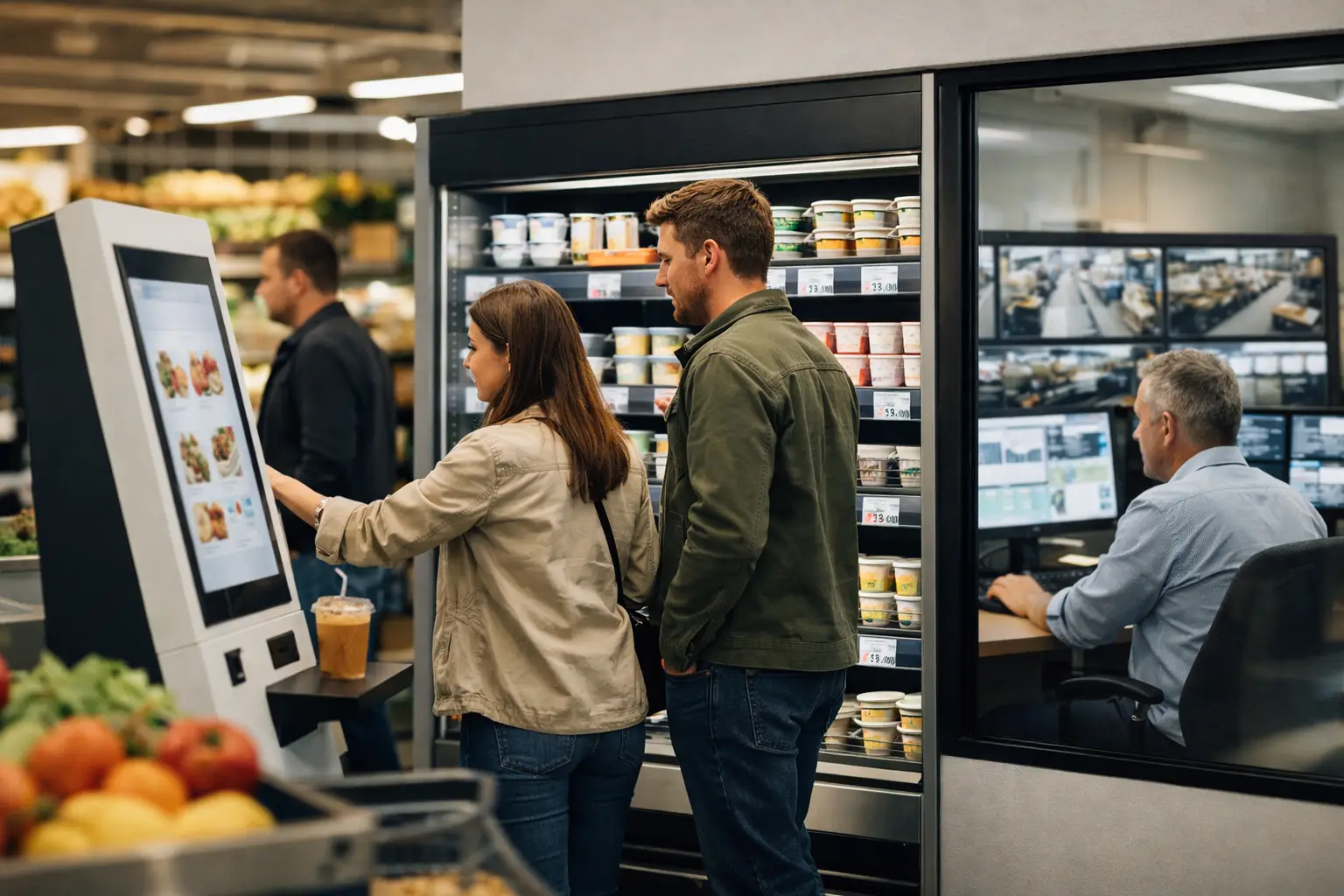
A useful supermarket automation example is not a store filled with isolated devices. It is a trading day where price changes, queue conditions, fresh-food messages, service requests, and operational alerts are coordinated through one governed operating model. The difference matters: a display that plays content is useful, but a display that responds to stock, time of day, store conditions, and centrally approved rules becomes part of the retail operating system.
For supermarket leaders, the business problem is familiar. Promotions change frequently, labor is under pressure, customers expect accurate information, and each store has its own local exceptions. The challenge is not simply adding kiosks, electronic shelf labels, cameras, or digital signage. It is maintaining control, traceability, and continuity when those technologies operate across dozens or hundreds of locations.
A supermarket automation example: one connected store model
Consider a regional supermarket group with 120 stores, a central commercial team, and store operations spread across several markets. Its objective is to reduce manual promotional execution, shorten visible checkout queues, and improve consistency between shelf pricing, digital messages, and local inventory conditions.
The group deploys commercial displays at entrances, in fresh-food departments, and above checkout lanes. Electronic shelf labels are introduced in selected categories. Self-service kiosks provide product lookup, loyalty enrollment, and service requests. IoT sensors and camera feeds provide operational signals, such as a queue exceeding a defined threshold or a refrigerated area requiring attention.
None of this delivers value by itself. Value appears when the estate is connected to centralized software with clear ownership, permissions, and automation rules. DEX Manager can serve as the control layer for retail communication: publishing approved content, assigning it by store or zone, scheduling promotions, and maintaining a full record of what ran, where, and when. C-Control can add an operational view for teams that need to monitor alarms, video sources, and live conditions across a distributed physical network.
The result is not an autonomous supermarket with no human oversight. It is a supermarket where routine execution is automated, exceptions are visible, and local teams can focus on decisions that need human judgment.
Start with the operational triggers, not the hardware
A credible automation program begins with repeatable operational events. For a supermarket, these might include a price change approved by merchandising, a queue threshold at checkout, an expiring fresh-food promotion, a maintenance alert, or a store-level service disruption.
Each trigger needs a defined response. If a queue reaches a set length, checkout displays can show a centrally approved message directing customers to open lanes or self-checkout. If a produce promotion is scheduled to end at 6 p.m., digital signage can switch automatically to the next approved campaign. If a refrigeration sensor reports an issue, C-Control can present the relevant operational context to the appropriate team rather than leaving an alert in a disconnected system.
This approach avoids a common failure mode: building automation around the technology that happens to be available. A camera does not improve queue management unless its data leads to a governed action. Electronic shelf labels do not reduce execution risk unless pricing data is integrated, validated, and published according to a controlled workflow.
Pricing and promotion execution
Price accuracy has direct customer, margin, and compliance implications. In a connected model, the merchandising team approves a campaign and its store eligibility centrally. DEX Manager distributes the associated visual communication to relevant displays while the pricing platform updates electronic shelf labels through its own integration path.
The important control is not that every screen and label changes at the same second. Some retailers need synchronized publication; others need a staged workflow that allows local confirmation before the customer-facing message appears. The right design depends on the maturity of pricing data, the type of promotion, and the consequences of a mismatch.
A governed platform provides role-based access, campaign approvals, scheduling, and proof of playback. This creates traceability when store teams, commercial managers, and customer service teams need to confirm what was communicated at a specific location and time.
Queue management without false precision
Queue automation is often presented as a fully automatic promise. In practice, camera analytics, sensors, point-of-sale data, and staff observation can all produce different signals. A well-designed system treats these inputs as operational indicators, not unquestionable facts.
For example, a store can define a rule that activates a checkout message when a queue condition persists for several minutes. The message may direct customers toward underused self-checkout stations, but it should not claim that a lane is open unless that status is confirmed. Store managers can retain the ability to override the message during staffing changes, equipment faults, or high-volume periods.
This is where central governance and local control need to coexist. Head office defines approved templates and escalation rules. The store controls live exceptions within its permissions. The automation reduces response time without removing accountability.
The architecture behind reliable automation
Supermarket automation must operate in an environment where network quality, store layouts, and device conditions vary. A cloud-managed architecture supports central deployment and policy control, but stores also need practical resilience when connectivity is interrupted.
DEX Manager is designed for managing distributed digital signage and physical communication endpoints. It supports centralized content operations across commercial displays, LED, videowalls, kiosks, and other compatible devices. Content can be targeted by country, store format, individual location, department, screen group, or time-based condition. For a supermarket network, that granularity prevents a national campaign from appearing in a store where the offer, language, or product availability differs.
C-Control provides a complementary operational capability where live monitoring is required. Security, facilities, and operations teams can bring together camera streams, IoT events, dashboards, and incident workflows in a control-room environment. The purpose is not to turn every store event into an alarm. It is to help teams identify conditions that affect safety, asset protection, customer flow, or continuity of operation.
Reliability also depends on device management. Teams need visibility into whether screens are online, whether players are operating as expected, and whether content has been delivered. At enterprise scale, remote monitoring and 24/7 operational support are not optional extras. They are part of the governance model for a customer-facing estate.
Where automation produces measurable operating value
The most valuable use cases are usually those with high repetition and a clear owner. In supermarkets, four applications frequently justify the operational effort:
- Promotion orchestration: Schedule department-level campaigns, daypart offers, and store-specific messages from a central calendar while preserving local exceptions.
- Customer flow communication: Use entrance, aisle, and checkout displays to direct customers during peak periods, self-checkout availability changes, or service interruptions.
- Fresh-food execution: Rotate content according to trading hours, planned markdown windows, seasonal availability, and local assortment priorities.
- Facilities and incident response: Combine sensor alerts, camera context, and escalation workflows so operational teams can assess issues faster and document their response.
Deployment choices depend on the retail operating model
There is no single correct rollout sequence. A retailer with weak product and pricing data should not begin by automating every shelf-label update. It may gain more value by first standardizing digital promotion governance and proving that content can be deployed reliably across stores.
A retailer with heavy checkout congestion may prioritize queue communication, self-service guidance, and operational dashboards. A high-volume fresh-food operator may start with time-sensitive messaging and markdown workflows. The best first phase is the one that has a measurable problem, a clear data owner, and a manageable exception process.
Deployment can be led by SIA Interactive or delivered through its certified partner network, depending on the project model and regional requirements. What remains consistent is the technology foundation: proprietary platforms, controlled integration, centralized administration, and an operational framework designed for large device estates.
The practical test is simple. Before adding another screen, sensor, or kiosk, define the event, the approved response, the responsible team, and the evidence required to prove it happened. When those four elements are clear, supermarket automation becomes a disciplined capability that can expand store by store without losing control.