
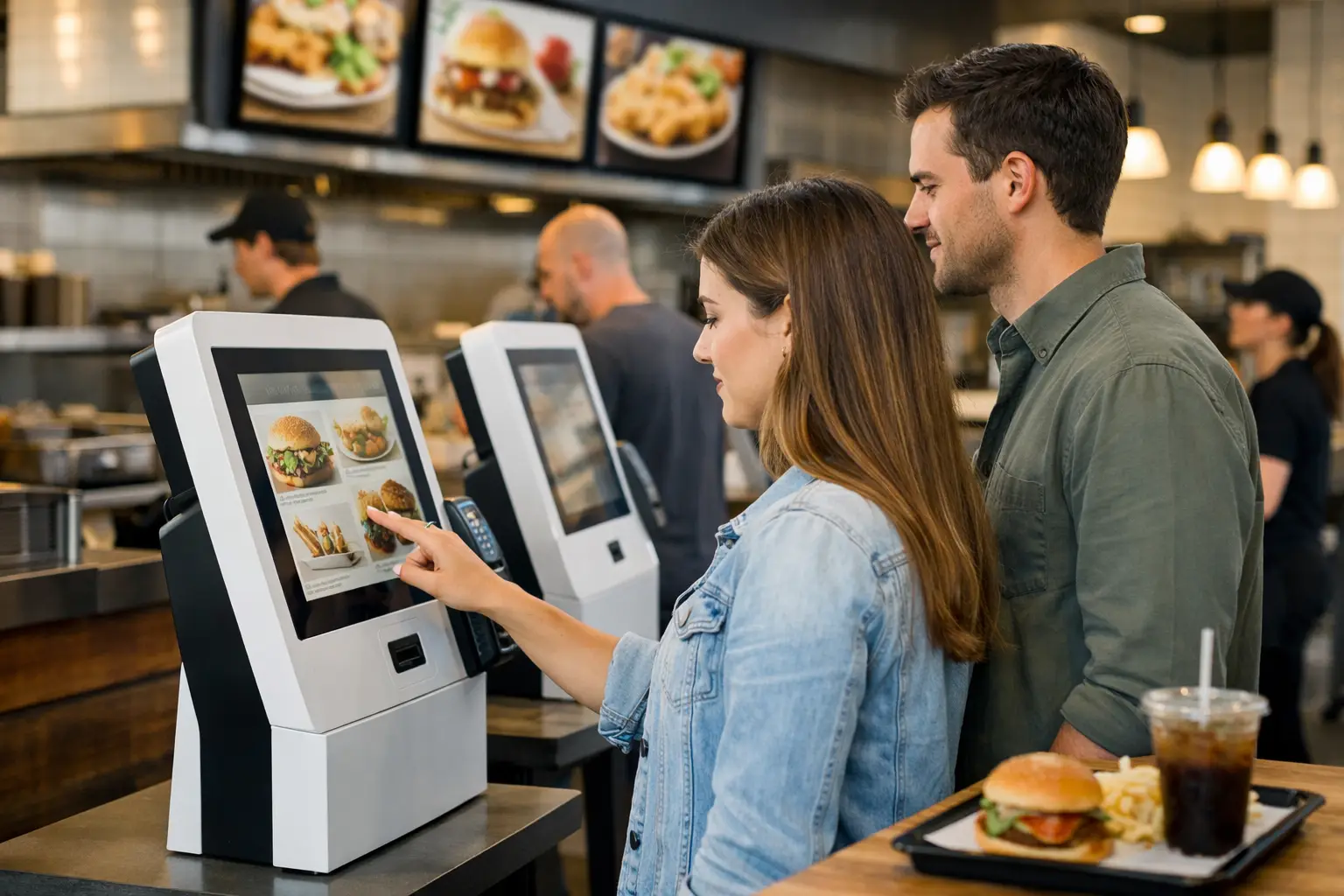
A self-order kiosk that accepts an order but displays the wrong menu at lunch is not a customer-experience asset. It is an operational failure visible to every guest in the line. Future restaurant ordering technology must therefore be evaluated as a managed physical-digital system, not as a collection of screens, tablets, and payment terminals.
For restaurant groups, the core question is no longer whether customers will use digital ordering. They already do, particularly where speed, order accuracy, and language flexibility affect the decision to visit or return. The harder question is whether the organization can govern thousands of ordering touchpoints across locations, formats, dayparts, and markets without creating a larger support burden.
Future Restaurant Ordering Technology Is an Operating Model
The visible interface matters, but it is only one layer of the architecture. A customer may encounter a kiosk, a digital menu board, a drive-thru display, a table-ordering screen, or a mobile handoff point. Behind each interaction are menu data, pricing rules, promotions, stock status, payment services, kitchen workflows, accessibility settings, and device health.
When these systems are managed independently at store level, inconsistency follows quickly. A promotional item can appear on a screen after inventory has run out. A kiosk can retain a previous price because its content update failed. A restaurant may lose ordering capacity during its busiest hour because no one identified a device fault until customers reported it.
The future is not one universal ordering interface. It is a governed architecture in which each channel serves a defined operational purpose while drawing from centrally controlled content, data, and workflows. Kiosks may reduce queue pressure. Digital menu boards can respond to daypart or stock conditions. Customer-facing order status screens can reduce uncertainty at pickup. The value comes from coordinating these components, not simply deploying more of them.
The shift from transactions to orchestration
Traditional ordering technology was often purchased to solve a single transaction problem: take an order faster, reduce labor at the counter, or add a payment option. Those are valid objectives, but a multi-site restaurant operation needs orchestration across the full service journey.
That includes determining which menu is available at a given location, whether the kitchen can support a promotion, how customers are directed when queues change, and what happens when a device or integration is unavailable. It also means retaining traceability: operations teams need to know what was published, when it changed, which locations received it, and whether the endpoint actually executed the instruction.
This is where a centralized platform becomes more consequential than the kiosk enclosure itself. Hardware is essential, especially in high-use restaurant environments, but hardware without governance creates a distributed estate that is difficult to control.
Design for Uptime, Not Just a Fast Rollout
Restaurant ordering systems operate during narrow windows of commercial opportunity. A failure at 3 p.m. may be manageable. A failure at 12:15 p.m., immediately before a stadium event, at an airport departure bank, or during a city-center lunch rush can affect revenue, labor allocation, and brand perception at once.
For this reason, future-ready deployments should define availability requirements before selecting interfaces. The relevant standard is not whether the screen turns on during installation. It is whether the ordering environment remains functional under real conditions: unstable network connectivity, payment-service interruptions, menu changes, peripheral failures, peak transaction loads, and store-level staffing constraints.
A practical architecture separates local continuity from central governance. The central platform controls content, configurations, permissions, reporting, and fleet status. Local devices need sensible fallback behavior when connectivity is interrupted, including clearly defined rules for cached content and transaction handling. The exact approach depends on the POS, payment environment, and restaurant format, but the principle is consistent: no site should be left without an understandable operating state.
Remote monitoring is equally important. Operations teams should be able to identify whether a kiosk is online, whether its display is functioning, whether content is current, and whether a peripheral such as a printer, scanner, or payment device requires attention. This turns support from reactive troubleshooting into managed continuity.
Standardization without losing local relevance
Large restaurant groups need central standards, but they also operate in markets with different languages, menus, store layouts, campaign calendars, and legal requirements. A platform that only supports complete central control becomes restrictive. A platform that gives every location unrestricted editing rights creates brand and pricing risk.
The workable model is role-based governance. Central teams control templates, approved campaigns, brand assets, and core rules. Regional or local teams can work within defined permissions to select approved content, activate market-specific menus, or schedule local messages. Every change should be attributable to a user and visible in an audit trail.
This is especially relevant for franchise and partner-operated networks. The objective is not to remove local operational responsibility. It is to provide a common technology framework that protects consistency while allowing controlled variation.
DEX Manager Connects the Customer-Facing Estate
DEX Manager addresses the management challenge at the center of distributed restaurant technology: how to operate digital touchpoints at scale with control, visibility, and repeatable deployment processes. It can manage customer-facing displays, self-service kiosks, digital menu boards, and communication screens through a centralized environment.
For restaurant operators, this capability supports more than publishing graphics. Menu and campaign content can be scheduled by location and daypart, deployed across selected device groups, and updated remotely when operations change. Device status can be monitored from a central control point, reducing dependence on store staff to verify each endpoint manually.
The platform is relevant where a restaurant estate includes multiple device types and business owners. Marketing may own campaign content. Operations may define menu availability and service messages. IT may govern access, integration, network policies, and incident response. Facilities teams may need visibility into physical device condition. A centralized platform gives these teams a common operational layer without requiring them to work through disconnected tools.
SIA Interactive owns DEX Manager and supports its deployment through its own teams and certified partner network, allowing restaurant groups to select an implementation route that fits their operating model. The technology authority remains with the platform owner, while certified partners can provide local delivery capacity and sector-specific project execution.
Integration Determines Whether the Experience Works
An ordering interface should never be treated as an isolated front end. Its usefulness depends on the accuracy and timeliness of the systems around it. At minimum, a future-oriented environment needs clear integration boundaries with POS, kitchen production, payment, loyalty, inventory, and business intelligence systems.
Not every restaurant requires every integration on day one. A quick-service chain with high volumes may prioritize POS and kitchen integration first because order throughput is the immediate concern. A premium casual brand may focus on table service, loyalty recognition, and order-status communication. A travel hub operator may need multilingual content and rapid menu switching across trading periods.
The discipline is to avoid integrations that sound attractive but add little operational value. Each connection should answer a specific question: Does it reduce manual work? Does it improve order accuracy? Does it prevent an unavailable product from being promoted? Does it provide data needed to make a service decision?
Integration also requires accountability. Teams should document which system is the source of truth for menu data, pricing, product availability, and customer identity. Without this, conflicting updates become inevitable, particularly when promotions change quickly or a chain operates across several markets.
Measure the Service System, Not Only Sales
Digital ordering produces useful signals, but transaction count alone is incomplete. Leadership teams need a view of how the entire service system performs. A rising kiosk conversion rate may be positive, for example, unless it coincides with longer kitchen times, abandoned orders, or a sharp increase in support incidents.
The most useful metrics connect customer behavior with operational health. These often include ordering completion rate, average order value, queue duration, order accuracy, device availability, content compliance, payment failures, and time from central publication to confirmed endpoint delivery. Each metric has a different owner, which is why a shared reporting framework matters.
Visual analytics can add another layer where it is deployed with a clear governance model. Footfall patterns, queue density, dwell time, and screen engagement can help managers adjust staffing, content timing, and physical layout. However, these capabilities should be implemented with appropriate privacy controls, defined data retention, and clear responsibility for how insights are used.
Build for Change at the Store Level
Restaurant formats change. A counter may become a pickup zone. A dining area may require more order-status communication. A drive-thru operation may add a second lane. A new market may need a different payment flow or language configuration. The technology estate should accommodate these changes without requiring a complete redesign each time.
That calls for modular hardware, centrally managed software, documented integration interfaces, and deployment standards that can be repeated across sites. Commercial-grade displays and kiosks matter because restaurant environments impose sustained use, cleaning requirements, heat, and customer contact. Yet standardized hardware should not mean a single configuration for every format. The right endpoint depends on traffic, dwell time, accessibility, service model, and available space.
The useful closing thought is this: the restaurants that benefit most from digital ordering will not be those with the most screens. They will be those that treat every screen, kiosk, menu, and message as part of one governed service operation - measurable from the center and dependable at the point of order.