
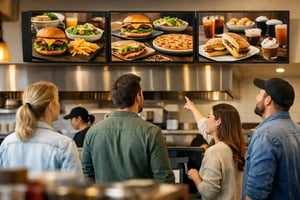
A menu change that reaches one location late can create a chain of operational problems: incorrect prices at the counter, unavailable items still promoted, staff explanations during peak periods, and inconsistent customer experiences across the brand. Digital menu boards for restaurants address that risk when they are designed as a managed communications system, not simply as screens displaying attractive artwork.
For restaurant groups, especially quick-service and fast-casual operators, the business case is not limited to replacing printed menus. It is about controlling what customers see at the point of decision, while maintaining governance over pricing, promotions, dayparting, allergens, and local availability. The relevant question is not whether a screen can display a menu. It is whether the organization can operate hundreds or thousands of screens reliably, with clear accountability and minimal intervention at store level.
Why restaurant menu operations need central control
Printed menus are predictable but inflexible. A price adjustment, limited-time offer, or supply interruption can require files, print production, shipping, replacement, and disposal. At scale, this process creates delay and makes it difficult to verify whether every site is showing the approved version.
Digital menus reduce that cycle, but only if the platform provides role-based governance and reliable distribution. Central teams need to publish approved content across the network while allowing authorized regional or store teams to manage local exceptions. A restaurant in one market may require a different language, product range, tax presentation, or promotional calendar. Local relevance should not become uncontrolled local editing.
This is where a centralized content management architecture matters. DEX Manager supports the distribution, scheduling, and monitoring of menu content across a distributed display estate. Corporate marketing can define templates and campaigns; operations can set availability rules; local managers can receive only the permissions needed for their sites. The result is traceability from content approval to on-screen delivery.
That governance is especially valuable when menus are connected to fast-moving operational data. If an item is unavailable, its placement on the menu should be reviewed immediately. In some cases, removing the item is the correct action. In others, the system can prioritize a comparable product, protect margin, or direct demand toward capacity that is available. The right response depends on the restaurant concept, inventory model, and integration maturity.
What digital menu boards for restaurants must do
A restaurant-grade platform has to manage more than playlists. It must support the operating conditions of the venue: high customer throughput, changing dayparts, varied store formats, intermittent connectivity, and the need for staff to focus on service rather than screen administration.
Schedule content by operational moment
Breakfast, lunch, afternoon, dinner, and late-night menus are often different commercial environments. Products, prices, imagery, and calls to action can change by hour, weekday, location, or event. Central scheduling makes these changes repeatable rather than dependent on manual intervention.
Dayparting also supports better use of the menu board as a sales tool. A breakfast promotion should not remain visible after service ends. A drive-thru message may require different timing from an in-store queue display. For operators with delivery pickup, kiosks, and counter ordering in the same location, each customer journey can require a distinct content rule.
Maintain pricing and product accuracy
A visually strong menu that shows the wrong price is an operational liability. Menu content should follow controlled workflows, including approval before publication, defined effective dates, and evidence of what was deployed. Audit trails are not only relevant to corporate governance. They help teams investigate customer complaints, confirm campaign execution, and reduce disputes between central and local operations.
Where the menu platform is integrated with POS, product information management, or inventory sources, automation can reduce repeated data entry. However, integrations should be assessed carefully. A direct data feed can improve speed, but it also creates dependencies. Operators need rules for failed feeds, invalid product data, and offline behavior so the display does not show incomplete or misleading information.
Verify uptime without waiting for a store call
The value of a digital menu is lost when a display is black, frozen, or showing expired content. For a distributed restaurant network, relying on managers to report faults is inefficient and inconsistent. Remote device monitoring provides operational visibility into player status, connectivity, playback, and display health.
DEX Manager enables central teams to monitor screen networks and identify issues before they affect a prolonged trading period. This visibility supports planned maintenance and clearer escalation to internal IT teams, field service providers, or certified partners. A platform should also be designed for continuity: local playback should continue during temporary network disruption, with synchronization resuming when connectivity returns.
Hardware choices affect customer experience
The software platform governs content and operations, but hardware selection determines whether the menu remains legible and available in the physical environment. A bright front window, a hot kitchen pass, a drive-thru lane, and a food court have different requirements.
Commercial-grade displays are generally better suited to long operating hours than consumer televisions. They are built for continuous use, remote management, and consistent image performance. Brightness must match ambient light, while display size and viewing distance must support quick reading from the customer’s actual decision point. An oversized screen with poorly structured content can be harder to use than a smaller, well-designed menu.
Mounting, power, network design, and service access also deserve early attention. Screens positioned above a counter may be difficult to maintain without appropriate access planning. For drive-thru deployments, weather protection, brightness, and vehicle viewing angles are critical. LED can be appropriate for large-format or high-brightness applications, but it is not automatically the right choice for an indoor menu where fine text readability is the priority.
Design for decisions, not decoration
Customers should be able to identify the category, product, price, and required qualification quickly. This sounds basic, yet many menu designs fail because motion, photography, and promotional messages compete with the transactional information customers need to order.
A useful approach separates permanent menu architecture from dynamic campaign space. Core categories and price points remain stable, while a defined area promotes a limited-time product, bundle, or upsell. This gives marketing teams room to activate campaigns without forcing a complete redesign at every change.
Animation should be used with restraint. It can draw attention to a featured item, but excessive movement increases cognitive load and can slow ordering. The same principle applies to personalization. Location-specific content, weather-based offers, and time-sensitive messages can be effective when they support a clear commercial decision. They become noise when every screen is trying to say something different.
Build an operating model before deployment
The most successful restaurant deployments define ownership before the first screen is installed. Marketing usually owns brand rules and campaign content. Operations owns availability, service priorities, and location exceptions. IT or technology teams own identity, network architecture, security, and integration standards. Facilities or field operations may own physical maintenance.
Without this model, digital menus often become stalled between departments: marketing has content but no publishing authority, operations has urgent changes but no approved template, and IT is asked to support devices that were not included in the standard environment. Establishing roles, approval paths, and service levels prevents these gaps.
A phased rollout is often preferable to a chain-wide launch. Pilot sites should represent different realities, such as a high-volume urban location, a drive-thru format, a mall unit, and a franchise-operated restaurant. The objective is not merely to test whether screens work. It is to validate content workflows, local permissions, connectivity resilience, service response, and the impact on staff routines.
SIA Interactive develops and owns DEX Manager, which can be deployed by SIA or through its certified partner network alongside professional displays, media players, kiosks, and related infrastructure. For enterprise restaurant groups, the value of this model is a defined technology foundation with accountability for the platform, while deployment can align with the organization’s preferred delivery route and regional operating structure.
Measure what the screens change
A menu board program should be evaluated against operational and commercial metrics, not screen count. Useful measures include campaign deployment time, percentage of locations showing approved content, mean time to identify and resolve device faults, product attachment rate, promotion uptake, and customer queue performance.
Not every improvement can be attributed to the menu alone. Sales can be influenced by staffing, weather, pricing, demand patterns, and store layout. That is why controlled testing matters. Compare similar locations, run campaigns over defined periods, and document what changed in the menu logic. Over time, this creates an evidence base for decisions about content, hardware, and integration investment.
The best digital menu boards do not ask restaurant teams to become signage specialists. They give the business a dependable operational layer: accurate customer communication, controlled change, visible device health, and a practical way to adapt the menu as service conditions change. That is the standard worth designing for before the first display is powered on.