
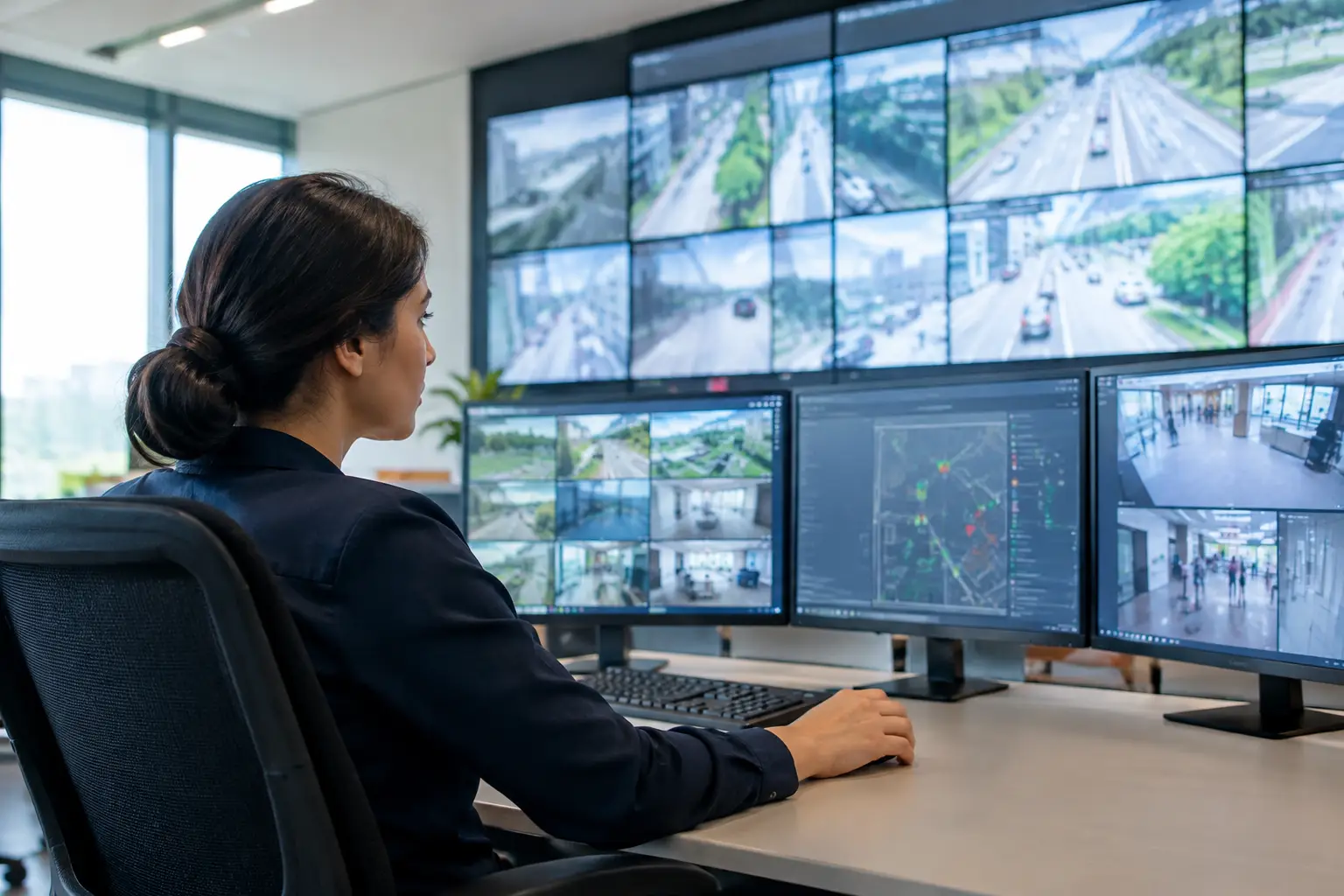
A control room does not fail only when screens go dark. It fails when operators cannot trust what they see, when an alarm reaches the wrong team, when a remote site cannot be verified, or when recovery depends on undocumented knowledge. This control room resilience guide focuses on the operating model behind uptime: the governance, architecture, monitoring, and recovery disciplines that keep critical environments under control.
For organizations managing security operations, transport, utilities, retail estates, corporate facilities, or distributed customer environments, resilience is not a single procurement decision. It is a system of decisions that determines whether the control room can continue to support operations during component failure, network degradation, cyber incidents, maintenance windows, and peak demand.
What a Control Room Resilience Guide Must Cover
Resilience starts with a precise definition of what must remain available. A control room may contain video walls, operator workstations, cameras, IoT sensors, incident dashboards, access-control feeds, and communications tools. Not every service has the same operational criticality. Treating them all as equally urgent creates unnecessary cost. Treating them all as noncritical creates exposure.
The first requirement is to classify services by their operational impact. For example, a live alarm feed may require near-continuous availability and rapid failover. A historical analytics dashboard may tolerate a delayed refresh. A content channel used for routine corporate communications can have a different recovery objective than a visual workflow that guides an emergency response.
This classification should establish recovery time objectives, recovery point objectives, ownership, escalation paths, and acceptable degraded modes. A degraded mode is not a vague fallback. It is a defined operating state: which information remains visible, which actions operators can still take, and who has authority to make decisions while full service is restored.
Start with dependencies, not displays
A video wall is the visible end of a larger architecture. Its ability to present trusted information depends on source systems, network paths, identity management, endpoint health, power, and operator permissions. A resilience assessment that starts at the display level can miss the actual point of failure.
Map the chain from data source to operator action. Identify where a single network switch, authentication service, API, or workstation configuration can interrupt the workflow. Then determine whether the dependency needs redundancy, an alternate path, a manual process, or simply better monitoring.
The answer depends on the consequence of interruption. Duplicate infrastructure without a tested process can add complexity without improving continuity. Conversely, a simple alternate view or a documented manual procedure can be enough for lower-priority workflows.
Build Governance Around Operational Criticality
Technology cannot compensate for unclear operational ownership. Resilient control rooms assign responsibility across platform administration, content and data validation, incident response, security, facilities, and business leadership. The goal is traceability: every critical configuration, change, alarm, and recovery action should have an accountable owner.
Change governance is especially relevant in environments with many sites and endpoints. A minor update to a layout, device configuration, integration, or user role can affect operator visibility at scale. Changes should be assessed by impact, approved according to risk, deployed in controlled waves, and validated against a rollback plan.
For multi-site organizations, governance also means defining what can be standardized and what must remain local. Core templates, access policies, device health rules, and escalation criteria are usually better managed centrally. Site-specific layouts, regional operating procedures, and local language requirements may need controlled flexibility. Centralization without local context can slow response; local autonomy without standards can make oversight impossible.
Design for Failure Without Creating Excess Complexity
Redundancy should be applied where it protects a critical function, not merely because duplication appears safer. The essential question is whether a component failure prevents operators from seeing, deciding, or acting.
At the infrastructure layer, this can include redundant power, network connections, cloud availability architecture, backup communications paths, and replacement devices for high-priority endpoints. At the application layer, it can include replicated configurations, protected data, role-based access, and controlled failover procedures. At the operational layer, it includes trained staff, clear runbooks, and a practical way to continue working when an integration is temporarily unavailable.
C-Control provides the control layer needed to coordinate visual operations across distributed environments. It can centralize the management of control room screens and connected endpoints, apply defined layouts and content rules, and provide visibility into device status. This matters because an operator should not have to rely on local intervention to restore a critical screen configuration or determine whether a remote display is functioning as expected.
A platform-owned architecture also creates clearer accountability for software evolution, security updates, and integration maintenance. C-Control can be deployed by SIA Interactive or through a certified partner network, allowing organizations to align delivery with their regional support model while retaining consistent platform governance.
Separate visibility from control
A common weakness is assuming that monitoring a device is the same as controlling it. Device health dashboards may show a display online while the intended content, camera feed, or operational layout is not actually available. Resilience requires both layers.
Visibility answers: Is the endpoint connected? Is the player operating? Has the expected layout been published? Are source feeds current? Control answers: Can an authorized team change the layout, restart a device, switch to a fallback view, or isolate a faulty integration without waiting for site access?
These capabilities should be measured against real operator workflows. A technically available system is not operationally available if staff cannot use it within the required response time.
Monitor the Conditions That Lead to Failure
Monitoring should identify deterioration before it becomes an incident. Basic online or offline status is useful, but it is not enough for critical environments. Teams should watch for recurring connectivity loss, delayed content synchronization, abnormal device temperatures, storage constraints, feed latency, repeated authentication failures, and unexpected configuration changes.
The value of monitoring increases when alerts are prioritized by business impact. An offline display in a training room and an offline screen showing live incident data should not create identical alerts. Categorization helps teams direct attention to the issue that affects continuity first.
This is also where visual analytics and IoT integration can improve decisions. Cameras and sensors may provide operational context for facility conditions, queues, security events, or equipment status. Their data must be governed with the same discipline as the rest of the control room architecture: validated sources, access controls, retention rules, and defined operator actions. More data is not automatically better. Information that is delayed, unverified, or poorly presented can increase cognitive load at the exact moment clarity is needed.
Test Recovery Under Real Conditions
A recovery plan that has not been tested is an assumption. Testing should cover more than a complete platform outage. Many real disruptions are partial: one site loses connectivity, a data feed becomes inaccurate, an operator account is unavailable, a device group receives the wrong layout, or a maintenance update must be reversed.
Run structured exercises that reflect these scenarios. Test who detects the issue, who is authorized to act, how alternate information is presented, how stakeholders are informed, and how the event is documented. Include both technical teams and control room operators. Technical recovery may be successful while the operational handoff still fails.
After each exercise or live incident, review the timeline. Look for delays in detection, decisions, escalation, communication, and restoration. Update runbooks based on evidence rather than assumptions. The most useful resilience improvements are often small: clearer ownership, a better alert threshold, a preconfigured fallback layout, or a more accessible escalation path.
Measure Resilience as an Operating Discipline
Availability percentages are necessary, but they do not tell the full story. A control room can meet a technical uptime target while suffering frequent short disruptions that interrupt attention and degrade operator confidence. Track service availability alongside mean time to detect, mean time to restore, recurring incident categories, failed changes, endpoint compliance, and the time required to switch to a defined degraded mode.
These measures should be reviewed by both technology and operations leaders. That shared review prevents resilience from becoming a purely IT metric or a purely facilities concern. It connects architecture decisions to the continuity of the business processes the control room exists to support.
The strongest control rooms are not those that claim never to fail. They are the ones that make failure visible early, contain its impact, restore service in a controlled way, and turn each event into a more reliable operating model.