
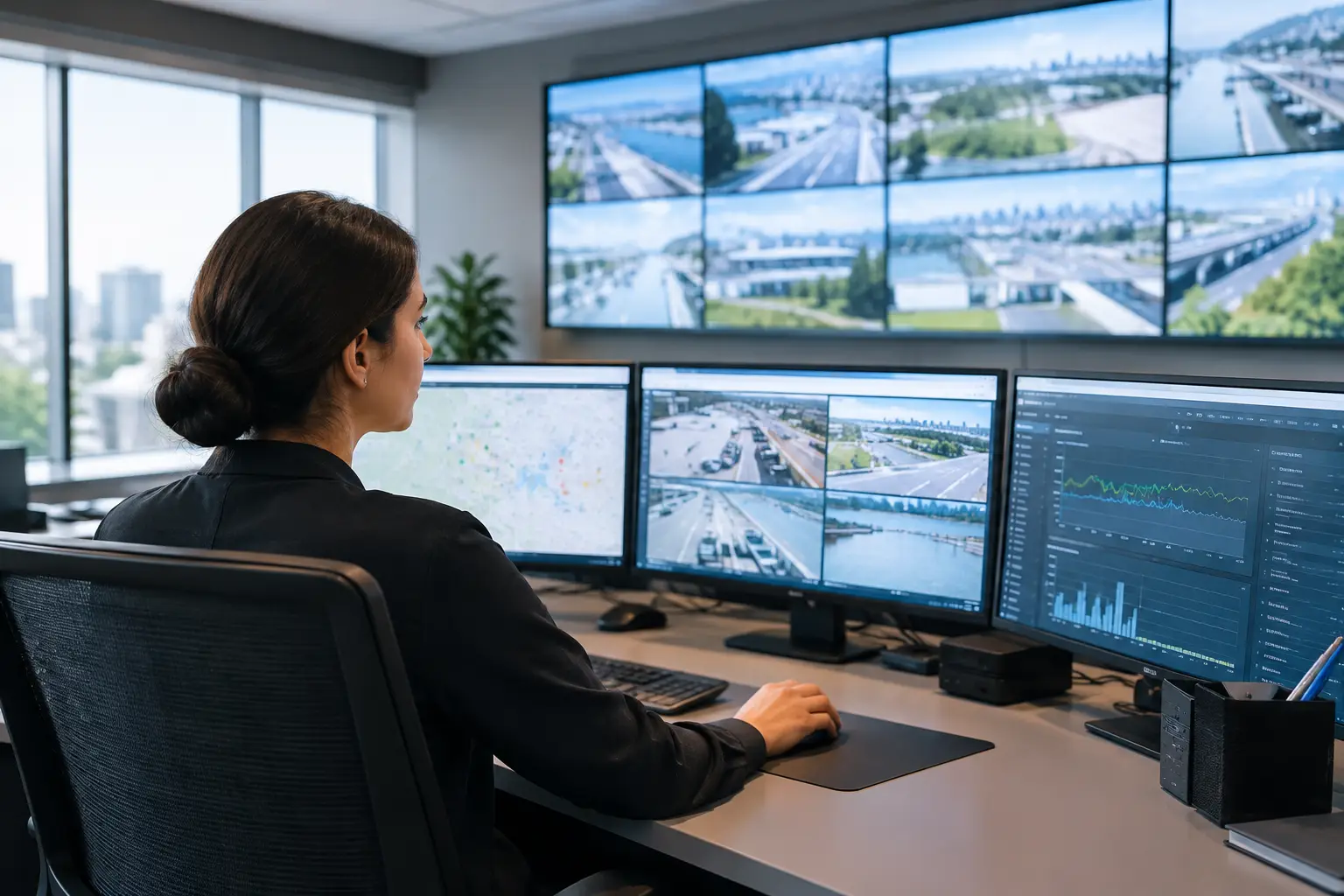
A control room can have every operational data source available and still leave its team reacting too late. The difference is not the number of screens. It is the ability to present the right operational context to the right role, maintain traceability, and act from one governed environment. That is why command center trends in 2026 are centered on coordinated visualization, automation, and continuity rather than display expansion alone.
C-Control is designed for this shift. The platform centralizes multi-source visualization in configurable views, allowing operations, security, facilities, and infrastructure teams to organize the systems they already depend on into a practical working environment. Video feeds, IoT data, maps, dashboards, alarms, web applications, and operational metrics can be arranged according to each workflow and level of operational criticality.
Command Center Trends Moving Beyond the Dashboard
For years, many control rooms added a new dashboard every time a new system was deployed. The result was familiar: separate logins, inconsistent alerting logic, duplicated monitoring, and operators moving between applications to understand one event. This approach can work in smaller environments, but it becomes difficult to govern when operations span sites, teams, and high-priority assets.
The prevailing trend is consolidation at the visualization layer. This does not necessarily mean replacing every specialized platform. A video management system, building management system, incident platform, or asset application may remain the system of record. C-Control provides the operational layer where their information can be visualized together in a unified view.
This architecture matters because a single incident rarely stays within one department. A power alert may affect access control, cameras, environmental conditions, customer-facing screens, and site occupancy. Multi-source visualization allows an operator to assess those dependencies without manually assembling the picture from five separate tools.
Role-based views are replacing one-size-fits-all walls
A large video wall still has a role in command centers, particularly for shared situational awareness. But the most useful environment is not one that shows everything to everyone. It is one that adapts the view to the operator's responsibility.
A security operator may require camera feeds, access events, perimeter alarms, and a site map. A facilities manager may need energy consumption, HVAC status, water sensors, equipment alarms, and maintenance indicators. An operations leader may need a higher-level view of service availability, escalation status, and performance across locations.
C-Control supports configurable views that can be designed around these distinct workflows. This reduces visual noise while preserving the ability to move from an executive overview to a specific operational source when an exception appears. The objective is control total over relevant information, not an overloaded wall of content.
Automation Is Becoming an Operational Requirement
Automation is no longer limited to sending alerts. The more mature command center model uses defined conditions to trigger content, change layouts, surface priority data, or guide operators toward the correct response process.
For example, an IoT sensor can indicate a temperature threshold in a technical room. That event can be visualized beside the associated camera, building system data, asset information, and escalation procedure. The operator still validates the situation and makes the decision, but the control room removes the delay associated with locating context.
This is a significant distinction. Automation should accelerate situational awareness and support repeatable processes. It should not conceal the source of an event or create actions that cannot be audited. In environments with high operational criticality, governance and traceability are as important as speed.
The appropriate level of automation depends on the use case. A retail operation may automatically switch digital signage content when a queue threshold is reached. A critical infrastructure environment may require human confirmation before a workflow proceeds. The platform architecture must accommodate both models, using integrations and configurable rules without forcing every operation into the same response pattern.
AI Will Be Valuable When It Reduces Operator Load
Artificial intelligence is appearing in control rooms through video analytics, anomaly detection, predictive maintenance, and event prioritization. Its value will be measured less by novelty and more by whether it helps operators focus on what requires attention.
A command center does not benefit from an additional stream of unexplained recommendations. It benefits when analytical output is linked to a location, asset, live visual context, and an established operational procedure. If an external analytics platform identifies an anomaly, C-Control can provide the visualization environment where that signal is viewed alongside the relevant operational sources.
This creates a practical division of responsibilities. Specialized systems generate detection or analysis. The command center platform organizes that information for monitoring and coordination. Teams retain visibility into the underlying source and can evaluate the confidence, impact, and required response.
Data Integration Is Now an Architecture Decision
The ability to connect systems is often described as a feature. For enterprise operations, it is an architectural decision with consequences for scalability, security, and continuity.
Control rooms increasingly combine legacy systems, cloud applications, connected devices, cameras, and enterprise data sources. The challenge is not only technical connectivity. It is maintaining a governed model for who can see which data, how information is refreshed, what happens when a source is unavailable, and how changes are documented.
C-Control is built for configurable multi-source visualization, with integrations deployed according to the operational landscape. This enables organizations to preserve investments in existing systems while creating a consistent operating layer across sites. It also makes expansion more manageable: new devices or applications can be incorporated into defined views rather than producing another disconnected monitoring silo.
Cloud scalability is particularly relevant for organizations operating distributed locations. Central teams may need consolidated oversight, while local operators require views tailored to their own sites. The right deployment model depends on data sensitivity, network design, latency requirements, and the availability targets of each service. A centralized command center does not always mean every source must be centralized in the same way.
Continuity and Cyber Governance Are Visible Operations
Command center trends are also raising the standard for platform governance. A control room cannot be treated as a presentation layer detached from IT policy. Its screens may expose live operational data, security video, building systems, and connected devices. Access control, monitoring, documented processes, and resilient infrastructure therefore affect day-to-day operational continuity.
For decision-makers, the key question is not simply whether a platform can show a data source. It is whether the complete operating model can support the required level of availability and control. This includes infrastructure design, user permissions, device monitoring, support processes, and an accountable escalation path.
SIA Interactive applies this approach through its proprietary platforms, Azure-certified infrastructure, ISO 27001 and ISO 9001 certifications, and 24/7 operational support. For teams managing thousands of devices or high-priority environments, these capabilities support a more controlled path from deployment through ongoing operation.
The Physical Control Room Is Becoming More Flexible
The physical environment is changing too. Fixed video walls remain valuable for shared decisions, incident coordination, and executive oversight. However, operators increasingly work across multiple zones, remote locations, and mobile or secondary workstations.
This means layouts must be transferable. A critical view configured for a main control room should be accessible in an alternative operating location when continuity plans are activated. It should also remain understandable on an operator workstation without relying entirely on a wall display.
Commercial displays, LED walls, and workstations still require professional hardware selection and monitoring. Yet hardware should follow the operational design, not dictate it. Screen size, resolution, mounting, redundancy, and room layout all depend on viewing distance, source types, and the decisions people must make from the displayed information.
Where These Trends Produce Operational Value
The strongest use cases are those where multiple data sources must be assessed quickly and coordinated across teams. Common applications include:
- Security operations: Combine cameras, access control events, maps, alarm states, and incident applications for faster context during an event.
- Facilities management: Visualize building systems, energy data, environmental sensors, maintenance information, and remote site status from centralized views.
- Infrastructure monitoring: Coordinate network, asset, service, and field-device information to identify dependencies and support service continuity.
- Retail and QSR operations: Monitor location performance, queue conditions, self-service equipment, digital communication, and connected devices across distributed estates.
Choosing a Platform for the Next Operating Model
When evaluating command center software, organizations should test more than the appearance of a demo wall. Ask how views are configured by role, how systems are integrated, how source availability is monitored, and how the platform supports governance as the environment grows. Also assess the operating model behind the technology: deployment expertise, support coverage, security controls, and the capacity to manage change without disrupting operations.
The command center of 2026 is not defined by how much information it displays. It is defined by how reliably it converts complex, distributed information into an accountable operational view. Start with the decisions your operators must make under pressure, then design the architecture, integrations, and visualization around those decisions.