
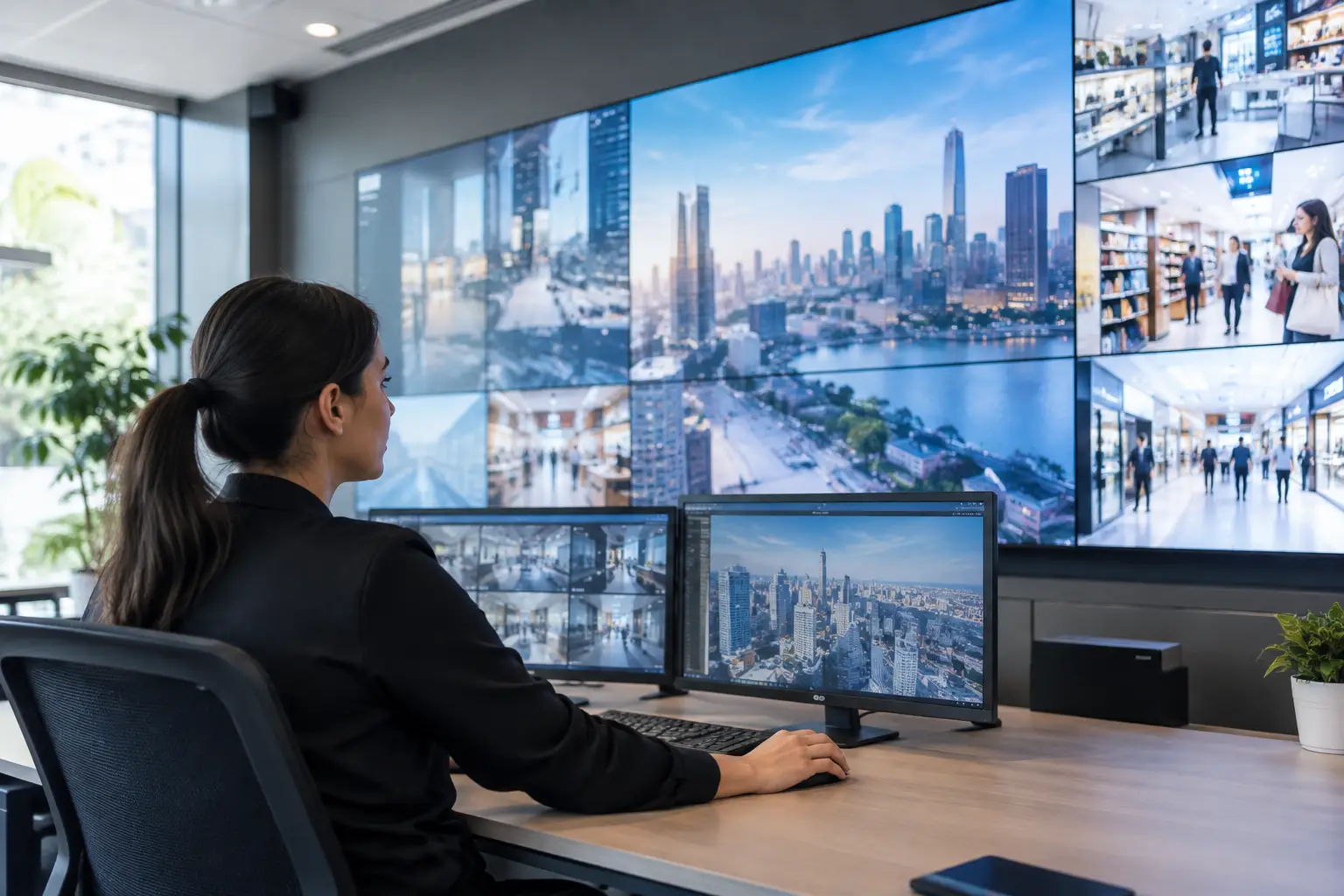
An LED wall in a command center, quick-service restaurant, trading floor, or flagship retail location is rarely treated as a short-duration display. It carries live operational data, pricing, menus, wayfinding, brand communication, or security information. So, can LED walls operate continuously? Yes - when the deployment is designed as a managed operational system rather than simply a large screen switched on all day.
The relevant question is not whether LED technology can run 24/7. Professional LED systems are commonly specified for continuous use. The question is whether the full architecture - LED modules, power distribution, cooling, controllers, network, content platform, and support process - can maintain the required availability without accelerating failures or creating an unmanaged operational risk.
What Continuous LED Wall Operation Actually Requires
Continuous operation is not the same as maximum brightness, maximum load, and zero intervention. A wall can be active around the clock while its brightness, content behavior, power use, and diagnostic checks are governed dynamically. This distinction has a direct effect on component life, image consistency, and energy consumption.
Commercial LED walls are built from modular cabinets containing LED modules, power supplies, receiving cards, and internal cabling. Each component has its own operating limits. Heat is the central issue. High brightness, white-heavy content, insufficient ventilation, and high ambient temperatures increase the thermal load on LEDs and power supplies. Over time, this can affect brightness uniformity, color performance, and component reliability.
A 24/7 specification should therefore be validated at the cabinet and component level, not inferred from the fact that the display is labeled commercial. Decision-makers should request the declared duty cycle, recommended ambient operating range, ingress protection where relevant, power consumption at typical and maximum content load, service access requirements, and spare-part availability.
Brightness Must Match the Environment
Brightness is often treated as a quality metric, but for continuous operation it is a governance setting. Indoor LED walls in corporate, retail, or restaurant environments usually do not need to run at their maximum output. Calibrating brightness to actual ambient light reduces heat and power consumption while improving viewing comfort.
Outdoor walls have a different constraint. They may need high daytime brightness to remain visible in direct sunlight, followed by substantial dimming after dark. An automated brightness schedule or sensor-driven adjustment protects the display from unnecessary high-load operation and helps meet site lighting requirements.
Content also matters. A persistent full-white visual consumes more power and generates more heat than a balanced layout with appropriate use of color and contrast. This does not mean operational teams must compromise visual clarity. It means content templates should be designed with the physical operating environment in mind.
The Hardware Design Behind 24/7 LED Reliability
A reliable LED wall begins with the right hardware class and installation design. Consumer-grade displays and LED products intended for occasional events are not interchangeable with systems required to carry business-critical communication continuously.
For an enterprise deployment, the cabinet structure and installation method must allow airflow, safe power distribution, and service access. Tight recesses with no heat path, crowded equipment rooms, or inaccessible rear cabinets can turn a technically capable wall into a long-term maintenance issue.
Power architecture deserves equal attention. LED walls draw variable power depending on content and brightness. Circuits, protection, cabling, and distribution equipment must be sized for the actual wall configuration and local electrical conditions. In critical locations, teams may also define resilience measures for the controller, network equipment, and power supply path rather than treating the LED surface as an isolated endpoint.
Redundancy is not necessary for every site. A retail campaign wall may tolerate a short recovery window, while a control center visualization wall may require redundant signal paths, backup controllers, and defined replacement-stock procedures. The appropriate design follows the operational impact of downtime.
Maintenance Is Part of Continuity, Not a Failure of It
No physical display estate is maintenance-free. Continuous operation works best when preventive maintenance is planned before visible degradation occurs. This can include cleaning, inspection of ventilation and connections, module calibration checks, firmware governance, and replacement of components approaching end of service life.
The modular nature of LED is an advantage because a failing module or power supply can often be replaced without changing the complete wall. But that advantage only becomes operationally useful when the organization has service access, compatible spare parts, a documented configuration, and a clear incident path.
For distributed estates, governance should define who can approve service activity, when maintenance windows occur, which parts are held locally or regionally, and how the wall is tested after intervention. This creates traceability instead of relying on informal knowledge held by a single site team or installer.
Monitoring Turns an LED Wall Into a Managed Asset
An LED wall can look operational from across a room while a cabinet, receiving card, or signal route is beginning to fail. Centralized monitoring helps operations teams identify exceptions before they become highly visible business incidents.
At a minimum, teams need visibility into player or controller connectivity, playback status, scheduled content, proof of display where applicable, and device health signals. More advanced environments may track cabinet-level faults, temperature alerts, power anomalies, and network status through integration with monitoring or building-management systems.
This is where the software platform becomes as important as the LED hardware. DEX Manager provides centralized control for digital signage estates, allowing authorized teams to schedule content, apply local or regional rules, confirm device status, and manage a large network from a single operational layer. It can be deployed by SIA Interactive or a certified partner, depending on the organization’s delivery model and geography.
Central control reduces a frequent 24/7 risk: unmanaged content. A wall may be technically healthy but still fail its purpose if it shows expired promotions, outdated emergency instructions, an incorrect menu, or a blank playlist after a local schedule change. Role-based access, approval workflows, publishing rules, and auditability are therefore part of uptime governance.
When Should an LED Wall Run 24/7?
The answer depends on the business function, not merely on what the hardware permits. In a control room, continuous operation is often justified because situational awareness cannot depend on staff arriving to switch systems on. In a bank branch or corporate lobby, the wall may run during building hours, then move to low-power informational content overnight. In quick-service restaurants, menu boards may operate through extended service periods but use scheduled dimming outside peak demand.
Retail is particularly dependent on a balance between availability and lifecycle management. A large LED wall at a storefront may need continuous operation for visibility and brand presence, but it should adapt to daylight, center operating hours, local campaigns, and public-safety requirements. A centrally governed schedule makes that adjustment repeatable across hundreds of sites.
There are also cases where switching off is appropriate. Planned downtime can support electrical work, deep cleaning, physical inspection, or a major content and control-system update. The objective is not to keep every pixel illuminated at all times. The objective is to maintain the required service level with deliberate control over risk, cost, and device life.
A Practical Readiness Check for 24/7 Deployment
Before approving continuous operation, technology, facilities, and operational teams should align on five questions:
- Is the LED wall and its supporting controller explicitly rated for the planned duty cycle and ambient conditions?
- Does the installation provide adequate cooling, power capacity, protective infrastructure, and safe service access?
- Are brightness and content policies designed to limit unnecessary thermal and electrical load?
- Can the organization monitor status, manage content centrally, and trace changes across every location?
- Is there a documented support model covering incidents, spare parts, preventive maintenance, and escalation?
A continuously operating LED wall should be treated like any other visible business system: specified for its real workload, monitored for exceptions, maintained through a defined process, and controlled through an accountable platform. That approach keeps the wall available when customers, employees, and operators need it most - without confusing continuous operation with uncontrolled operation.