
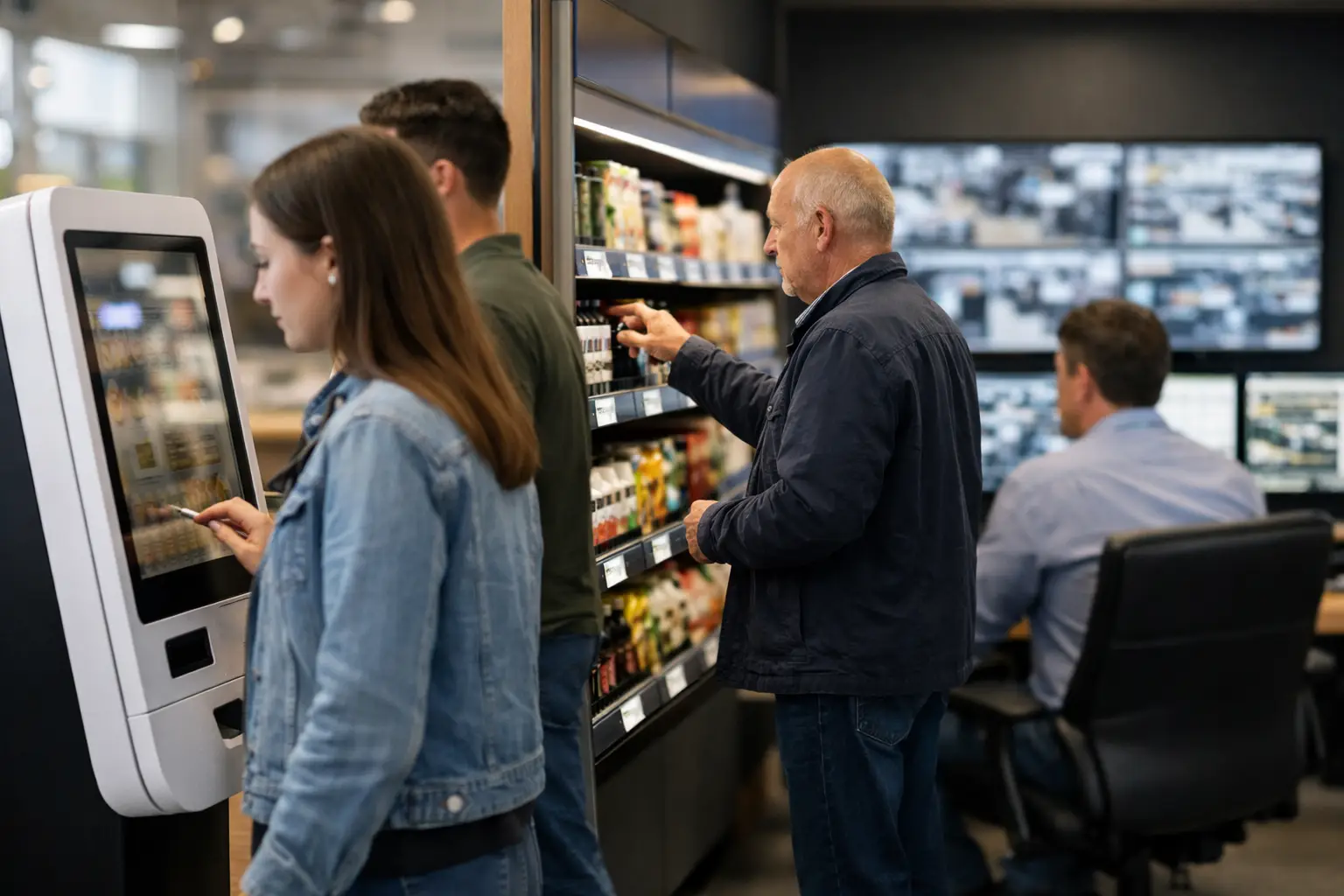
A store can accept payments without a cashier, replenish screens without a local technician, and route customers through self-service without constant staff intervention. But autonomous retail operations only create value when those actions remain visible, governed, and recoverable from a central operations function. Autonomy without control simply moves operational risk from the counter to the network.
For multi-site retailers, the real question is not whether a store can run with fewer manual tasks. It is whether every device, customer message, transaction flow, and exception can be monitored and managed consistently across the estate. That requires an architecture built for uptime, traceability, and controlled change.
Autonomous retail operations are an operating model
Autonomous retail is often reduced to self-checkout, smart shelves, computer vision, or cashierless payment. Those technologies matter, but none of them independently creates an autonomous operating model. A retailer still has to manage pricing content, device health, queue conditions, security alerts, stock signals, promotional rules, and local exceptions.
The operating model becomes autonomous when routine decisions can be triggered by defined conditions and executed through connected systems. A queue threshold can activate additional self-order guidance. A product availability signal can remove an out-of-stock item from a menu board. A refrigerator sensor alert can notify the appropriate team while recording the incident. A failed display can be identified remotely before store staff report it.
Each action needs governance. Operations leaders must know what triggered the change, which system approved it, where it was applied, and whether the result was successful. This is particularly relevant when a network spans hundreds or thousands of locations with different formats, operating hours, languages, product ranges, and promotional calendars.
The control layer determines whether autonomy scales
Retail devices generate activity, but a device estate is not a control system. The control layer connects business rules to physical execution. It provides the structure for publishing content, monitoring endpoints, assigning permissions, scheduling changes, and responding to exceptions without relying on manual intervention at each site.
DEX Manager provides this layer for distributed digital signage, self-service, and physical-space communication. From one management environment, authorized teams can control commercial displays, video walls, self-order kiosks, electronic shelf labels, and connected devices. The goal is not simply to publish a campaign faster. It is to maintain control total over how customer-facing systems behave in operationally critical locations.
This distinction matters during disruption. A campaign manager may need to change menu availability across a region within minutes. A facilities team may need to identify a group of screens affected by a connectivity issue. A security or operations center may need to replace standard content with safety instructions. These are different workflows, but they depend on the same capabilities: centralized visibility, role-based governance, remote execution, and auditability.
C-Control extends that approach into command-and-control environments where visual communication, status data, alarms, cameras, and IoT signals must be brought into a coordinated operational view. In large retail estates, the boundary between store operations and a control room is becoming less distinct. A remote team needs the same situational awareness that a store manager once gained by walking the floor.
Build autonomy around exceptions, not ideal journeys
The strongest business case for autonomous retail operations is usually found in the exceptions. A self-service journey may work perfectly for most customers, but the operation is judged by what happens when a payment fails, a kiosk loses connectivity, a restricted product requires approval, or a digital price does not match the promotional rule.
A mature design separates routine automation from escalation. Routine actions should execute consistently according to approved rules. Exceptions should surface quickly, reach the correct owner, and leave a traceable record. This prevents local workarounds from becoming invisible operating practice.
It also prevents over-automation. Not every decision should be made by a rule engine. For example, automatically changing content based on footfall can improve relevance, but it may conflict with a priority campaign, a local safety notice, or a regulatory requirement. Human approval remains necessary for high-impact changes, while low-risk adjustments can be automated within defined limits.
That balance depends on the retailer's format and risk profile. A high-volume quick-service restaurant may prioritize order throughput and menu accuracy. A supermarket may focus on price integrity, fresh-food availability, and queue management. A bank branch may place greater weight on privacy, accessibility, and security. The platform architecture should support those differences without creating separate, unmanaged technology stacks.
What a governed retail architecture needs
Autonomous operations depend on an integrated environment rather than isolated point solutions. The core requirement is that software, hardware, data sources, and operating teams can work from a common model of the physical estate.
Four capabilities are especially consequential:
- Centralized device management: Operations teams need real-time status, remote configuration, scheduled updates, and clear ownership for every endpoint. A screen that is powered on but showing outdated content is not operationally available.
- Integration with business and IoT data: Content and workflows become more useful when they respond to inventory, point-of-sale, order management, occupancy, temperature, queue, or service-ticket signals. Integration should be controlled through defined interfaces, not improvised at individual stores.
- Role-based governance and traceability: Retail marketing, IT, facilities, security, and local operations need different permissions. The system should record who changed what, when, and across which locations.
- Operational resilience: Cloud scalability matters, but so do local network conditions, hardware monitoring, fallback behavior, and 24/7 support processes. Critical customer communication cannot depend on an assumption that every endpoint will always be online.
Start with a repeatable deployment pattern
A controlled pilot should prove more than customer acceptance. It should test the operational processes needed to scale: provisioning, content approval, user access, incident response, remote monitoring, replacement procedures, and partner handoffs.
The first locations should represent real operating conditions. A flagship site with dedicated technical support can hide deployment gaps that become visible in smaller, high-traffic, or remotely located stores. Test the network at different times of day, simulate device failures, and define what happens when data from an upstream system is late or unavailable.
Once the pattern is validated, scale through standardization rather than copying a local configuration from store to store. DEX Manager can be deployed by SIA Interactive or through a certified partner network, allowing organizations to maintain a consistent software and governance model while using delivery resources that fit their regional operating structure.
A practical rollout also defines ownership before the first device goes live. Marketing may own campaign rules. IT may own identity, connectivity, and cybersecurity standards. Facilities may own physical maintenance. Store operations may own local recovery steps. The central operating team needs visibility across all of them, because customer experience failures rarely stay within one department.
Measure outcomes beyond labor reduction
Labor efficiency is a valid measure, but it is not enough. A retailer can reduce counter tasks while increasing calls to a help desk, maintenance visits, abandoned orders, or customer confusion. The better measure is whether autonomy improves performance without reducing operational control.
Track device availability, content compliance, mean time to detect and resolve incidents, transaction completion, queue duration, intervention rate, and the percentage of changes executed remotely. These indicators show whether the system is reducing friction or merely relocating it.
The most valuable result is operational confidence: the ability to make a controlled change across a physical network, verify its execution, and respond quickly when reality differs from the plan. That confidence is what allows autonomous retail operations to expand from an isolated store concept into a dependable retail capability.