
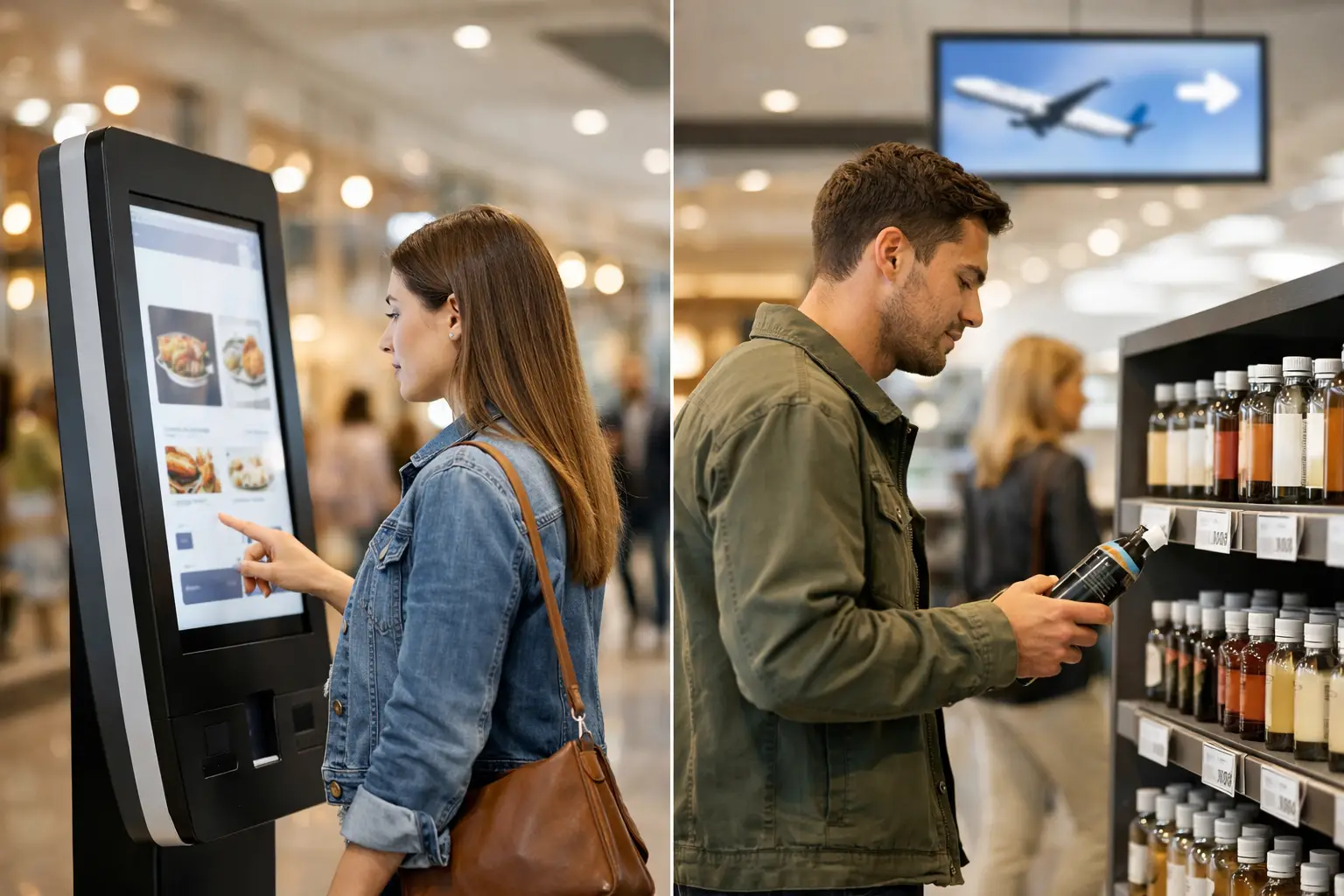
A display network becomes difficult to govern when every message depends on a person noticing a change, creating a file, and publishing it at the right time. That model breaks down quickly across stores, restaurants, campuses, bank branches, and control rooms. To automate contextual space messaging is to make the physical environment respond to verified operational conditions without giving up central control.
The objective is not to put more content on screens. It is to ensure that the right content appears at the right location, on the appropriate device, for the defined duration, based on data an organization trusts. A queue message should respond to actual wait conditions. A menu board should reflect inventory and daypart rules. A workplace display should switch to emergency instructions when an incident is confirmed. These are governed operational decisions, expressed through physical communication.
Why static messaging creates an operational gap
Traditional digital signage scheduling works well for planned campaigns, brand content, and recurring communications. It is less effective when the message depends on a changing local condition. Teams then compensate with manual intervention, local workarounds, or broad messaging that lacks relevance to the space.
The result is familiar: promotions remain on screen after a product is unavailable, staff receive late instructions, customers are directed to closed service points, or a control center has information that does not match the current state of the operation. The issue is not screen capacity. It is the missing connection between real-world signals, decision rules, and the devices communicating in the space.
Contextual messaging closes that gap. It uses approved inputs such as POS systems, queue-management platforms, occupancy sensors, weather services, building systems, security events, inventory data, or corporate feeds to determine what should be displayed. The automation must be governed carefully. An inaccurate data source can distribute an inaccurate message at scale, so reliability is a design requirement rather than an afterthought.
Define the context before you automate it
A useful automation program starts with decisions, not with content templates. Operations, communications, IT, facilities, and security teams should identify the situations where a message can improve a measurable outcome. In a quick-service restaurant, that may mean moving demand toward available menu items during a stock exception. In retail, it may mean changing a zone message when footfall is high or a promotion is active. In a corporate facility, it may mean publishing location-specific instructions during a service disruption.
Each use case needs a clear context model. That model answers four questions: what signal triggers the message, which system is the source of truth, which locations and devices are affected, and what rule ends or overrides the message.
A queue threshold, for example, should not automatically produce the same instruction at every site. A branch with a self-service kiosk may direct customers to that kiosk. Another branch may redirect visitors to an alternative service desk. The operational condition is shared, but the response is location-specific.
This is where organizations often over-automate. Not every live data point deserves a message. If content changes too frequently, screens become noisy and staff lose confidence in the communication. Set thresholds, minimum display periods, suppression rules, and priority levels so automation reflects meaningful changes rather than normal operational variation.
Automate contextual space messaging with DEX Manager
DEX Manager provides the control layer for turning approved data and business rules into coordinated physical communication. It centralizes device management, content distribution, scheduling, monitoring, and automation across distributed networks of commercial displays, LED, videowalls, kiosks, and other connected endpoints.
The platform can be deployed by SIA Interactive or through a certified partner network, using an architecture suited to the organization’s network, security, and operational requirements. For enterprises operating thousands of devices, the central requirement is consistent governance: the same rule logic, content approvals, user permissions, and device visibility must apply across regions while allowing controlled local variation.
A practical automation flow has three layers. First, an external system or IoT device provides a trusted event or data value. Second, DEX Manager evaluates the defined condition and selects the approved content, layout, or playback scenario. Third, the platform publishes that scenario to the assigned endpoints and records delivery status.
This approach avoids treating every integration as a custom one-off project. The logic can be designed around repeatable operating patterns: daypart changes, threshold alerts, inventory states, occupancy conditions, scheduled events, sensor readings, or operator-confirmed incidents. The exact integration method depends on the source system and security model, but the governance principle remains the same: no message should be activated without a known source, an accountable owner, and an auditable rule.
Priorities and overrides protect business-critical communication
Contextual communication is valuable only when it behaves predictably under pressure. A promotional campaign cannot take precedence over an emergency instruction. A local operator should not be able to override a centrally mandated security message without authorization. Likewise, a stale API value should not leave an outdated operational alert on screen indefinitely.
DEX Manager scenarios should therefore include a priority hierarchy. Emergency and life-safety instructions sit at the highest level, followed by critical operational notices, then local service information, and finally planned commercial content. Expiration conditions and fallback content are equally important. If an external feed fails, the platform should return the screen to an approved default state or maintain a validated message according to policy.
This is particularly relevant in control rooms, transportation-adjacent environments, financial services, and large corporate campuses, where display behavior is part of operational continuity. A platform must provide both automation and the ability for authorized teams to take manual control when conditions require it.
Match devices to the decision being communicated
The message logic is only one part of the deployment. Hardware placement and device type determine whether people can act on the information. A commercial display at a restaurant entrance can set customer expectations before ordering. A menu board can influence choice at the point of decision. A self-order kiosk can convert a queue-management message into a transaction path. Electronic labels can reflect product and inventory context directly at shelf level.
C-Control extends this model to environments where operational data must be monitored and acted upon across complex device estates. In a command or control setting, teams may need a unified view of visual systems, connected equipment, and room-level functions. The value is not simply central control of screens. It is traceability over the state of the environment and a faster response when conditions change.
Organizations should also design for device health. A contextual message that is correctly triggered but sent to an offline endpoint has not achieved its purpose. Monitoring, proof of playback, remote diagnostics, and 24/7 operational support are material capabilities for networks where availability affects revenue, safety, or service quality.
Use cases where context changes the result
For restaurant chains, contextual messaging can align menu boards, counter displays, and pickup screens with daypart, inventory availability, order volume, and local promotions. The goal may be to reduce ordering friction, direct demand toward available capacity, or limit customer disappointment caused by unavailable items.
For retailers and supermarkets, the same principles support localized offers, queue guidance, fulfillment instructions, and employee communications. The most effective deployments do not attempt to personalize every screen continuously. They identify the moments where operational context materially changes customer behavior or store efficiency.
Banks can use contextual messaging to direct visitors between teller, advisory, and self-service options based on branch conditions. Corporate enterprises can coordinate meeting-room, reception, and employee communications with calendar, occupancy, and facilities data. In each case, the display is not a passive publishing endpoint. It becomes part of the operating model for the physical location.
Build governance into the rollout
Start with a limited set of high-value scenarios and test them in representative locations. Measure whether the source data is timely, whether the rule produces the intended behavior, and whether local teams understand the message. A technically successful integration can still fail if the communication is unclear or if front-line staff are not prepared for the operational change it creates.
Define ownership early. IT may own integration security and access controls; operations may own trigger thresholds; communications may own message approval; facilities may own location maps and device placement. DEX Manager can centralize execution, but governance depends on clear accountability across these functions.
Track more than impressions. Useful measures include time from event to screen update, playback confirmation rate, device availability, reduction in manual publishing activity, queue duration, conversion toward alternative services, and the number of exceptions requiring operator intervention. These measures show whether automation is improving continuity rather than merely increasing content activity.
The strongest contextual messaging programs make physical communication dependable enough to be used in real operations. Begin with one decision that currently relies on manual reaction, connect it to a verified signal, and give it a controlled path to the people standing in the space when it matters.