
IOT SENSORS
We connect the physical environment with the digital ecosystem.
IoT sensors enable the space to respond in real time to people, products and environmental conditions, integrating directly with DEX Suite and DEX IoT.
PRESENCE SENSOR
Detects movement in front of the display.
- Automatic screen activation
- Intelligent power on for energy saving
- Triggering of contextual content
- Ideal for shop windows and high traffic areas

BRIGHTNESS SENSOR
Dynamic adjustment according to environment.
- Ambient light measurement
- Automatic brightness control
- Energy optimization
- Adaptation to interior and shop window
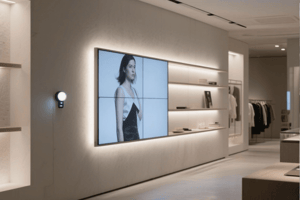
RFID (LIFT & LEARN)
Product-screen interaction.
- Raised product detection
- Automatic content activation
- Real-time comparative information
- Ideal for experiential retail

MAGNETIC POSITION SENSOR
Handling control.
- Detects lifted or returned product
- Triggers associated content
- Integration with interaction analytics
- Applicable in showcases or displays
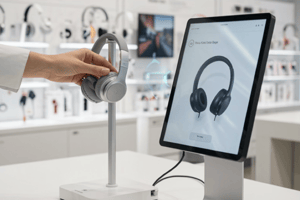
CONFIGURABLE PHYSICAL BUTTONS
Direct interaction at the physical point.
- Manual activation of options
- Language or content selection
- Immediate control in showroom or technical room
- High operational reliability
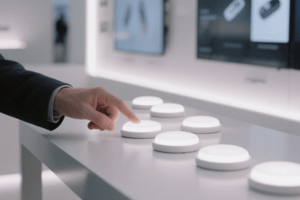
AIR BUTTON (NON-CONTACT)
Hygienic and safe experience.
- Proximity activation
- No physical contact
- Integration with kiosks or displays
- Ideal for healthcare or retail environments
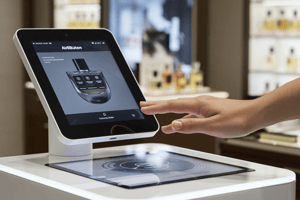
SENSORS AS A LAYER OF OPERATIONAL INTELLIGENCE
IoT sensors are part of the DEX ecosystem. They enable presence, product or environmental conditions to trigger content and generate structured data to optimize operation in real time.
Sensors act as triggers within the DEX ecosystem.
Presence, product manipulation or environmental conditions automatically trigger content, campaigns or scenarios defined by business rules.
Activation is not binary: it is based on configurable rules.
It is possible to define conditions such as time slot, product category, occupancy level or type of space to dynamically adapt the content.
Each interaction generates operational data: exposure time, activation frequency, manipulation or dwell time.
This data is structured and stored for further analysis and continuous optimization.
Sensors can be combined with visual analytics systems to enrich context.
This allows cross-referencing physical interaction data with audience metrics and content performance.
Activation does not affect only one screen.
It can synchronize LED, stretch, kiosks or Retail Media, generating coordinated experiences throughout the physical space.
All devices are configured and monitored remotely.
Firmware update, parameter adjustment and homogeneous deployment in multiple locations under the same control model.
TECHNOLOGY WITH OPERATIONAL RESPONSIBILITY
The value is not in the device, but in how it is integrated, deployed and managed within your operating model.
KEYS TO SENSOR INTEGRATION
Critical aspects on activation architecture, data capture, operational continuity and centralized control within the DEX ecosystem.
They allow the physical space to stop being static.
They activate content, collect data and generate contextual logic in real time, connecting physical behavior with digital strategy.
The sensors are connected through the DEX IoT module, which acts as the management core.
Activation rules, behavioral parameters and network deployment are configured centrally from the platform.
No.
They are part of a connected architecture that allows to orchestrate multiple devices: LCD, LED, stretch, kiosks or Retail Media, generating coordinated experiences.
No.
Presence, brightness or position sensors operate without individual identification.
They are designed to comply with privacy regulations and operate under anonymization models.
Frequency of activation, interaction time, product handling, occupancy by zone or behavior in front of a display.
This data allows you to optimize layout, content and commercial strategy.
Yes.
It is possible to configure combined conditions (schedule, category, traffic level, active campaign) so that the content responds to business logic and not only to a physical event.
Yes.
The architecture allows homogeneous deployments in multiple locations with centralized governance and controlled local adaptation.
No.
They are industrial devices designed for operational stability.
Remote monitoring allows preventive maintenance and parameter updating without constant physical intervention.
